The highs and lows of writing

Producing a novel has often been compared to giving birth – giving birth after what is usually a prolonged gestation. The creative labour is a journey with many stages, from the first spark of an idea to typing the last words, and this lengthy process involves substantial pain as well as joy. You hope it will end on a high of creative satisfaction followed by the reward of holding a physical book in your hand, but the road is long and hard, the happy outcome elusive.

Whether the idea comes in a sudden flash of inspiration or forms gradually over time, it brings a certain thrill of anticipation, which only increases as it takes substance. At the same time the enormity of the challenge becomes all too obvious. The story must be more than an idea. It needs immersion in a place and a time period, the painstaking construction of the protagonists as individuals. Above all it needs a structure. You are beset by countless decisions: who will narrate the story and will it be in first or third person, or even second? Will you write in past or present tense? Will it progress chronologically or will you move back and forth in time, starting at a dramatic moment perhaps? How will the story end?

The research alone can take many months, maybe years – reading, interviewing people, building up background and particularities to ensure authenticity. It can feel like a slog or it can bring its own rewards: a sense of discovery, the fascination of new knowledge, curiosity satisfied.

As the project slowly evolves in your mind and the different elements begin to gel, it’s time to devise an outline and then to start writing. Details are magically filled in as you write; plot ideas, sentences and phrases come like lightning bolts out of the blue. They come when your mind is relaxed, open and receptive – probably not at your writing desk but out in nature, on the beach or walking in the hills. The buzz this provides beats any drug-induced high.

Over time, the novel takes shape, the word count grows. There may be pauses when the way forward eludes you or when life gets in the way. Progress is rarely consistent: there will be spurts of joyful creativity and periods when a long day at your desk produces no more than an uninspired sentence or two accompanied by feelings of despair.

And then suddenly, after months or years of effort, you are approaching the end, galloping on – if you’re lucky – towards the novel’s resolution. Euphoria hits as you type the final words. You enjoy a private celebration, time off from your all-consuming mission. But after a couple of days you realise how lost you are without it. You start mourning the characters who had become your closest friends. The completion of your work feels like a bereavement too.

So when the process resumes with the editing stage, it comes as a relief, a welcome return to the grindstone. Until the dismay sets in at how much work still remains to be done. All those decisions you made at the beginning, which now seems so long ago you can hardly remember your reasons, must now be re-examined: the structure, the point of view, the all-important opening page. Questioning everything, from the big picture down to the minutiae of each sentence, phrase and word. Some of the words you laboured over so long must now, you realise, be excised. Is that delete button your friend or your enemy? How cruel it feels to be cutting out treasured scenes, minor characters for whom you still nurse affection but who may be superfluous and only serve to distract. Cutting and polishing – it sounds like a visit to a nail salon but although it may hurt, there is satisfaction in the final result.

Now the moment has come to share with a few trusted friends, your ‘beta readers’, what has until now remained entirely private. This baby you have jealously guarded to yourself must be exposed to the critical eyes of others. You quake and drag your heels, terrified by the power you are giving them: the power to utterly destroy your ambitions, your self-confidence as a writer and even, by extension, as a person.

When the feedback is positive, bringing praise rather than disparagement, the relief is huge. You take note of the helpful suggestions and minor criticisms, edit a little more and feel buoyed up – enough to invest in the bigger challenge of a professional critique. Because how can you rule out the possibility that your friends were merely being kind, reluctant to risk hurting you or damaging your relationship? Only an impartial expert – one who knows the market – will be incisive and honest enough to give you a meaningful evaluation. The report comes back and your heart sinks. There is encouragement certainly, but also negative comments, advice you disagree with and some that you now see is sound and perceptive and must be acted on. Deflated, you go back to work, forced to make more difficult decisions. How much credibility should you accord this one expert, who admits her view is subjective?

If this stage is difficult, the one that follows is worse. You sweat over a cover letter, revise your synopsis, research suitable agents and the few small publishers who accept manuscripts direct from authors. Then, together with your initial chapters, you send them out. And wait. You wait a long time. After weeks or months you might receive a standard rejection or if you’re lucky, a more personal and encouraging rejection. From some you will hear nothing. Agents are bombarded by submissions, they tell you: up to 10,000 a year, of which they accept two or three.

I think of this as the heartbreak stage. All that time and emotional energy, the work of several years dismissed in a few seconds of an agent’s busy day. Six of my earlier novels still languish on antiquated floppy discs or on a series of broken, long-discarded computers, copied onto memory sticks; some sit in paper version on my bookshelves. Once again I am faced with decisions. Should I give up? Work on it more? Self-publish as I successfully did with my last novel? Meanwhile I fantasise about the breakthrough, the email or call that will change everything.

And then it happens. The emotional rollercoaster has ended, as I hardly dared hope, on a high. I have a publishing contract in my hand. I’m exultant. I’ve arrived at what feels like the end of a long journey, though in fact it’s only the beginning.

Now, while the excitement of preparing for publication builds up, I must start all over again: open my mind to new inspiration, the spark that ignites my next novel.

Postscript: The rollercoaster ride has not ended after all. Six months after the signing of the contract, it is withdrawn by the publishers. They have changed their priorities; the list for 2019 must be cut down and refocused on more commercial genres. I feel as if I’d been flung to the ground from a great height. Who would choose to be a writer?

BUT THEN… Three miserable months later, out of the blue comes an email from the publisher. It seems a change of heart is on the cards. The terms will not be as good but if I can accept them, they will go ahead and publish my novel after all. Suddenly my world is turned right way up again. Relief is too puny a word to describe how I feel.


After the Civil War: Spain’s hunger years

Last week it finally rained – two days of heavy rain, falling as snow on the sierras. With reservoirs at 37% of capacity, the rain dominated the news; people cheered and sighed with relief. In the south of Spain, the number of rainy days since spring can be counted on one hand. This year’s drought is the worst since 1992-95. Some crops are badly affected; inevitably food prices will rise, and as always, it is the poor who will suffer.

The years following the end of Spain’s Civil War in 1939 also saw a severe drought that lasted three years. It was the last thing the country needed. Food was in any case scarce, partly because the fields had been neglected during the war. Huge numbers of working men, the family breadwinners, had been killed or maimed or were imprisoned. Even after the fighting had stopped, retribution against Republicans continued. Franco was intent on rounding up as many ‘enemies’ as possible, so that all those with Republican sympathies lived in constant fear. Some 300,000 had gone into exile; others fled to the hills. Tens of thousands of prisoners were executed; large numbers died as a result of the dire conditions in gaols and camps (TB and typhoid were rife). Prisoners were used as slave labour in the mines or on construction projects, where they were exposed to grievous dangers. Those who survived were permanently weakened. Amongst the general population, illness and malnutrition caused innumerable deaths.

The situation in Spain was incomparably worse than in European countries affected by the Second World War. With the country isolated, a policy of autarquía (autarky or economic self-sufficiency) was decreed. The 1940s were known as los años de hambre, the ‘hunger years’. Women would scour the hillsides for herbs and grasses. Thistles, acorns, orange and lemon rinds – anything remotely edible – served as food. For some, prostitution was the only way to feed themselves and their children. Others resorted to stealing cabbages from the fields or digging up newly planted potatoes. If they were caught, they would get a beating from the Guardia Civil.

Cuts in the supply of energy were frequent, so that in winter people suffered terribly from the cold; water was also scarce in some places. Working conditions and wages had deteriorated dramatically. While widows of the nationalists received a pension for their husbands, this was denied to the widows of ‘reds’. The illnesses of poverty and poor diet were rife.

Rationing had been introduced in 1939 but was hopelessly inadequate, lacking the minimum level of nutrition for subsistence. It was also open to abuse, to which the government turned a blind eye. In fact it suited Franco to have the population crippled by hunger and disease.

1952 CARTILLA RACIONAMIENTO CD ENRIQUE OLIVER IBAÑEZ (1)

In theory, the weekly rations consisted of 125g of meat, 1/4 litre of oil, 250g of black bread, 100g of rice, 100g of lentils, one egg and a piece of soap. In practice, what was usually available was chickpeas, sweet potatoes, pasta for soup, some salted cod and very small amounts of oil, sugar and soap. Meat, eggs and milk were rarely distributed. Some flour and milk were provided for children. Women struggled to construct meals from the sparse ingredients available to them. Journalist Claudio Grondona, in an article years later for Diario Sur, wrote about how they had to fry food without oil, make tortillas without eggs, stews with only bones, coffee from roasted barley or wheat.

th-4

White bread was a luxury item and the black bread ration was soon reduced to 150 or 200g. The ‘black bread’ was dense and hard, difficult to swallow. It might contain sawdust, straw or small stones. Often it was made from maize, chickpea or carob flour rather than wheat. However, those who had fought for Franco received an extra 250g of bread and the military, guards and priests were allowed 350g of white bread.

While the poor barely survived, often obliged to work from before dawn till long into the night on empty stomachs or at best one scant meal a day, the rich were doing very nicely. Private property had been restored, the privileges of Church and Army reinstated. In my forthcoming novel, The Red Gene, Consuelo’s adoptive family, being well-off landowners, suffer no hardships. On the other hand, the people in the Alpujarran villages, family home of another of the characters, suffer intense privation in the postwar years.

Prices of basic provisions had been fixed at the same level as existed in 1936, before the war. However, manufacturers and shopkeepers objected to this and either kept goods locked away in warehouses awaiting more profitable times or channelled them to more lucrative markets, adding to the already significant shortages. Bartering goods and services became common as the black market was only accessible to the well-off. Sugar and oil, for example, were sold at ten times the value fixed for the rationing system, which lasted for thirteen years.

In such a climate of deprivation as affected the majority of the population, the black market naturally thrived. It was known as el estraperlo, a word the people coined from Straperlo, the name of an infamous business run by two Dutchmen called Strauss and Perlowitz, who caused a scandal during the 2nd Republic with their fraudulent electric roulette machine. It was the black market that defined the social differences in postwar Spain. The estraperlistas, those who ran the black market, were protected by the regime; many of them became rich.

So while the winning side with good jobs were well nourished and lacked little, the survivors from the losing side, including professionals deprived of their jobs (and often their academic qualifications too), suffered all the illnesses caused by malnutrition, unless they were lucky enough to have a relative on the fascist side who supplied them with foodstuffs. Worst off were the crippled or sick without any kind of work, those who were incarcerated in prisons, camps or living on the street.

There are still some alive who remember how it felt to be hungry – those now in their 80s and 90s, who would have been children or adolescents then. They are unlikely ever to forget.


Travel and Tourism

When I first left Europe to travel overland across Asia in the mid-seventies, I proudly classed myself as a ‘traveller’ rather than a ‘tourist’. There was a kind of snobbery in this, I have to confess. Travelling involved more contact with local communities, it avoided resorts and holiday destinations; it meant seeing and experiencing ‘real life’ in distant parts of the world, discovering the culture at first hand, preferably through personal interactions. We travellers were aware, respectful, anxious not to exploit the inhabitants of countries we visited. Or so we liked to think. We did not stay in luxurious hotels or travel in air-conditioned buses or relax on beaches prohibited to the inhabitants. Instead we camped or slept in cheap, neighbourhood accommodation, sometimes situated in red-light districts. We mostly used ordinary buses and trains, squashed together with local travellers and their bedrolls and produce and chickens. And yes, we felt superior to mere tourists.

About twenty-five years ago, the morality of tourism began to be questioned. Flying harmed the environment; cultures were corrupted by the intrusion of curious westerners. I had experienced trips that promised contact with Kalahari bushmen or other ‘native’ tribes, ‘contact’ that turned out to involve a humiliating show of customs no longer observed, costumes no longer worn but displayed purely for our benefit, and had felt acutely uncomfortable with them. When I returned to India in the 90s, ‘responsible’ travel was catching on. I wrote to Ranjit Henry, an ebullient socialist from Chennai who believed passionately in ‘soft tourism’. He offered an ethical way of travelling in small groups (4 in our case), often staying in the houses of friends of his, living almost as part of the family (though of course we were paying). We would have long conversations over meals, get invited to weddings, learn the secrets of Indian cooking. Travelling independently and alone, I again stayed with families, some of whom became friends. On my most recent visit five years ago, I was hosted by Villageways, a cooperative that involves local communities, benefitting them as much as their guests. Travelling in this manner, I felt more like a guest than a tourist.

Tourism has been receiving a bad press recently. Cities like my own adopted home-town of Granada are changing, turning into ‘theme parks’ according to some residents. The number of tourists has increased with every passing year. Whereas once it was visited – in relatively small numbers – by those interested in its Moorish culture and architecture, now the availability of low-cost flights and unofficial cheap accommodation has led to a massive influx that threatens to overwhelm the resident population. The vast majority are respectful but sadly it is not that uncommon to see a camera pointed into someone’s home as if the inhabitants were part of a tourist spectacle. There are also the stag and hen parties (a custom that has now spread to Spanish couples) interested only in the city’s bars and restaurants, where prices have risen steeply while quality has generally fallen. The small traditional shops that served residents have gone out of business one after another and been replaced by shops geared to tourists.

The same is happening in Barcelona, in Venice and in many small and picturesque cities throughout Europe and beyond. It is happening in Amsterdam, where residents are beginning to protest (as they have in Barcelona). In a few weeks I plan to visit Amsterdam and my conscience is pricking. Instead of observing the effects of tourism from a resident’s point of view as I do in Granada, I will be one of them, part of the ‘problem’. It is 27 years since I last visited Amsterdam and I expect to see changes similar to those I have observed in Granada over the last 20 years.

So should tourism be controlled? Whose rights should predominate: residents’ or visitors’? Can it promote a mutual appreciation and understanding of other cultures, other ways of living, or is it a selfish activity, its only benefit to bring money and employment to certain sectors, a minority of the population? Does it broaden the mind or turn the world into a theme park?

As a former travel writer and journalist, I bear some responsibility. We are the greatest promoters of tourism, singing the glories of the places we know and love, sharing their secrets, encouraging visitors with glowing descriptions and captivating photos. Those enticed by the publicity are hardly to blame.

It will do me good to be a tourist myself. It will remind me that away from where we live, we are all tourists (even if we prefer to think of ourselves as travellers or explorers). It will also remind me that travel is a privilege, one that demands sensitivity, humility and respect.


A Space to Write

While some writers take their laptops to busy coffee shops, I need the tranquillity of my writing desk at home. The spare bedroom is my haven of solitude and silence, a place where I can enter into the world of my protagonists without the distraction of other people, noise, activity of any kind. No music, no chatter, no coffee machines, clinking of glasses or scraping of chairs, no traffic din.

IMG_20160424_203926440_HDR

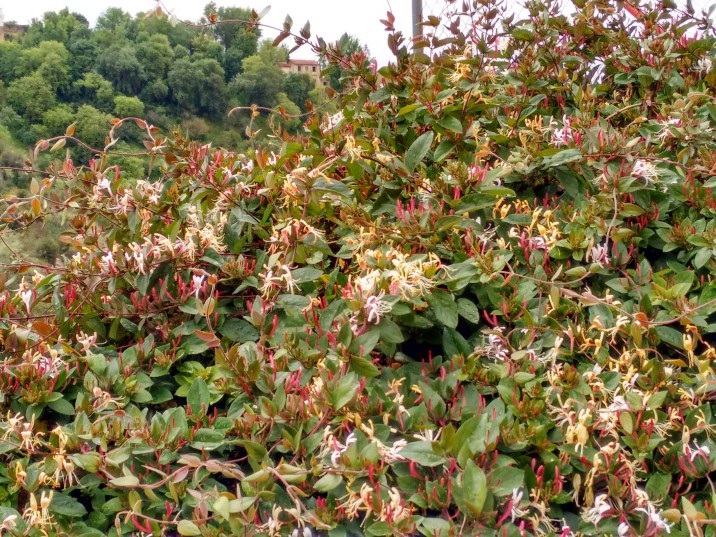
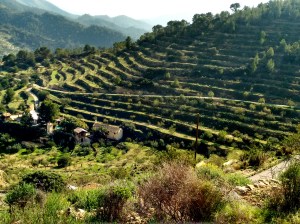
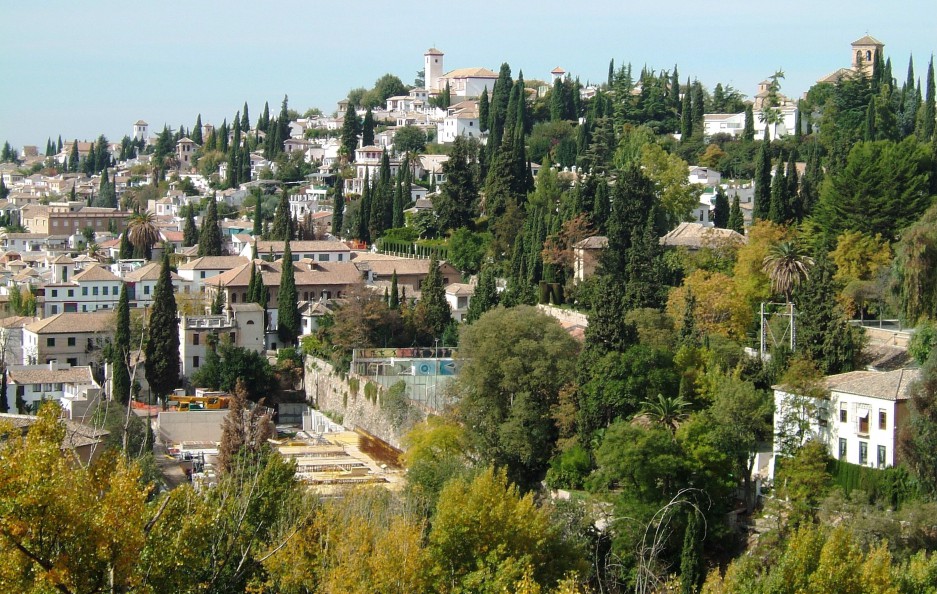
The sun illuminates my writing space, encouraging creativity. Through the window, my view is of the wooded hills across the valley of the river Darro. If I lean backwards a little, I can see the Generalife, the summer palace of the Alhambra built by the Moors. Closer in my field of vision is the rampant honeysuckle on my terrace. In spring, when it flowers, I open the window and its gorgeous scent wafts in. Whatever the time of year, I only have to turn my head slightly to catch sight of the pinky-mauve bougainvillea and the miniature pomegranate bush.


IMG_20160507_130942475_HDR

On the wall in front of me is a corkboard with photos of family; of people and places I love. It also has a postcard given me by a friend, with an inspiring quote from Goethe: Whatever you dream you can do begin it. Boldness has genius, power & magic in it. Begin it now. I read it often. Mementoes from my travels – batiks from Africa and Asia, small sculptures in ebony, a painting by a dear friend – adorn the walls and surfaces. Books litter the spare bed, scraps of paper with notes cover the desk. It is not a particularly tidy space.

I can write elsewhere, of course. All I need are quiet surroundings free from interruptions, away from commotion and clamour. In Bristol, an attic room with windows each end that give me the morning sunrise and evening sunset provides another peaceful haven. I have spent occasional periods of two or three weeks at writing retreats. The best was a residency in Mojacar, Almería with my own room in a beautiful artists’ house with meals and laundry service provided and the company of other artists from all over the world. One retreat was in the countryside near Comares in Málaga, another at Relleu, a mountain village in Alicante province, run by poet Christopher North.

IMG_20151116_093309

IMG_20151109_135248553_HDR

We are all different. I can understand that for other writers, the lively atmosphere in a café or pub can be stimulating and necessary. Or it may be that they are less disturbed and distracted than they would be at home. I realise I am privileged to live in a beautiful place and also that living alone as I do is very different to living with a family or housemates. While some writers find music helpful to their creative process, I find it intrusive.

IMG_20161121_094420022_HDR-EFFECTSIMG_20151105_111644390_HDR

Writing seems to me a magical process. Where do ideas spring from? What triggers the imaginative leaps, the entry into other worlds? Internal and external stimuli contribute in different and often inexplicable ways. As Goethe said, we must dream and be bold enough to believe we can do it, bold enough to begin it now, in whatever environment inspires us

Names

Choosing names for the characters in my novels is one of the more enjoyable elements in the initial stages of putting together a story. Names have to come early on in the process but that doesn’t mean they can’t change. Alice in Secrets of the Pomegranate only became Alice in the final draft when I realised – confirmed by feedback – that her previous name absolutely didn’t fit. I had chosen it before I had a clear idea of who she was.

To give it authenticity, a name must be true to the background and historical period as well as to the personality of the protagonist. It must be distinctive enough to remain in the mind of the reader and not too similar to the names of other characters in the story. Names are influenced by fashion every bit as much as clothes or music so it’s worth consulting the lists of names popular in the relevant decade; they are easy to find, along with their meanings. In my new novel, The Red Gene, not yet published, my main protagonist Rose is born in the second decade of the 20th century. She has become so real to me, so firmly identified with the name I’ve assigned her, that I can’t imagine changing it now. Her brothers are Ralph and Bertie, her contemporary friends Mabel and Dorothy – names you would be unlikely to find in the next generation, born in the 40s and 50s. Rose’s nephews and nieces are Helen, Peter, Susan and Robert, while their children have names more fashionable in the 70s and 80s: Zoe, Zach, Oliver, Samantha…

Choosing Spanish names proved rather more complicated. Until forty years ago, the Church dictated what names were allowed, with a prescribed list for parents to choose from: saints or particular images of the Virgin Mary. There was no opting out, no chance to pick a fancy foreign name or commemorate your favourite footballer or film star. Hardly surprising then, that Spain is so full of Josés and Marías or amalgamations of the two, José María for boys, María José for girls. Despite the extensive choice of available saints, Mary and Joseph have predominated in the popularity stakes. This, along with the tradition – almost universal until relatively recently – of naming firstborn children after their parents, limits the number of names in circulation. There are still people who believe that Christian names should be inherited in the same way as eye colour, artistic talent or property, preserving them in the family to show respect for their antecedents.

In selecting names for my Spanish protagonists, I had to balance authenticity against the need to avoid confusion. Even if I disregarded the custom of passing a name down the family, I still had to consider how similar these saintly names can sound to a non-Spanish ear. The characters’ names are one element in setting the tone of the era and social milieu in question – in this case Catholic Spain during the dictatorship, a society where the influence of the Church weighed heavy. Incarnation, Adoration, Conception: such names would surely be considered cruel in Britain but in Spain their equivalents are – or used to be – commonplace. Catholic girls had to suffer some of the most depressing names in existence. Grief, pain and anguish were, apparently, the foremost emotions that came to mind when a baby girl was to be named. As well as Dolores (grief or pain – a reference to Our Lady of the Sorrows) and Angustias (anguish), there is Soledad signifying the loneliness of the Virgin at the Passion of Christ. Cruz or Crucifixión and Expiración suggest yet more suffering.

The qualities of virtue and purity were invoked with particular frequency for the female sex, with names such as Piedad (piety), Inmaculada (immaculate) and Sacramento (sacrament). With so many oppressive religious names, short forms are a blessing. Concha (shell) sounds a good deal more palatable than Concepción. Dolores can be reduced to Lola, Inmaculada to Inma, Purificación to Puri, Adoración to Dori. Boys’ names can also be tough to live up to: the deeds or qualities expected of a boy named Jesús or Salvador (saviour) must be formidable, while Ángel, Gabriel and Miguel are all angels; Serafín is an angel of the highest order.

Being so universal, many of these names appear in The Red Gene, a story that spans seventy-five years of Spanish history. Consuelo, born in 1939, has four brothers: Francisco (probably the most popular boys’ name in Spain), José María, Rafael and Juan, while the parents in this staunchly Catholic, landowning family are María Angustias and José. She has a friend Puri and aunts Inma and Adoración. By the later years of the dictatorship, society was becoming somewhat less oppressive and this is reflected in parents’ choice of names. Consuelo’s longed-for fifth child is named Marisol, María of the Sun: her mother hopes she will ‘bring sunshine into their lives.’

A law was passed by Franco in 1941 that allowed children forcibly removed from their Republican parents – for adoption by ‘persons irreproachable from a religious, ethical and nationalist point of view’, naturally – to be inscribed in the Civil Register under a new name. This practice, which made irregular adoptions much easier, continued throughout the dictatorship, that is, until 1975. Consuelo in The Red Gene has the name given her by her adoptive parents, thus successfully disguising her origins.

Spanish Crossings

The Spanish Civil War has been the inspiration for many novelists, myself included. In this post, I interview John Simmons, who has recently published a novel with a Civil War background. Spanish Crossings (Urbane Publications, 2017) is set mostly in 1930s and 40s London but his characters, English Lorna and Spanish Pepe, are deeply affected by what is happening in Spain.

John, I believe you drew on events in your own family history to write this novel. Could you tell me something about that?

Back in 1937, my mum and dad, Jessie and Frank, were young, newly-married and committed to fighting the rise of fascism. When 4,000 refugee children arrived in Britain from northern Spain, sailing on the boat Habana from Bilbao, they volunteered to ‘adopt’ one of the children. I knew him only from photographs in our family album, and that his name was Jesús. He had returned to Spain, and I had never met him or heard anything more from him. In my family, growing up in the 50s and 60s, Spain was a forbidden country – we boycotted it because of Franco’s dictatorship.

Unfortunately my mum and dad died when I was a teenager so I didn’t get to ask them all the questions that I would now wish to ask. But three years ago my daughter Jessie (named after my mum) gave me a book Only for Three Months (by Adrian Bell) that told the story of the refugee children. It’s an extraordinary and little-known story, and it was one of my main sources in writing Spanish Crossings. It allowed me to reconnect with my family history and to take that as inspiration for the novel.

Your descriptions of 1940s London come across as very authentic. How did you go about researching the background for this novel?

That time was history for me, but it was also only a few years before I was born. I remember growing up in flats facing a bombed site from the war. Those flats were Levita House that feature as a location in part of the novel. The main detail – particularly of the 1943/44 period – came from reading. I found the local history archive in Holborn Library useful for articles; read a lot of fiction written and set in the period; and found contemporary photographs amazingly evocative.

Is the story of Lorna and Pepe based on any real history you discovered in your research?

Neither character is directly based on a real character but each is an amalgam of people I knew or read about. People often assume Lorna is based on my mum, but she isn’t – though I imagined my mum might have been present as an observer in many of the scenes. Pepe came mainly from my imagination and reading, but probably the most important influence was a photograph of a boy called Angel who was a friend of Jesús.

How would you describe Lorna? Did you find any problems in writing from the point of view of a woman?

The first words for the book – “Mother declared herself happy” – came to me in a dream when I was staying in Seville in 2014. That’s the only time that has happened to me. I wrote down the words in my notebook when I woke up and that day I wandered around Seville writing in my notebook while sitting in cafes and parks. By the end of the day I had the first draft of what is now the Prologue of Spanish Crossings. So my first writing about Lorna (as I subsequently called her) was in the form of a frail old lady visiting Spain for the first time in the mid-1980s. But the Prologue established so many threads of the backstory, and I wanted now to imagine what Lorna had been like in her prime, in the 30s and 40s.

It was a great starting point, having that backstory, and Lorna came to life in my head fairly easily. I’d been brought up in a household where left-wing politics were constantly discussed, so Lorna came out of that knowledge and experience. I’d seen and heard people who were politically idealistic, as Lorna is, and I’d seen that this didn’t make them romantic dreamers. They wanted to do practical things to make the world a better place. Lorna has that aspiration, even as she realises the difficulty of her ambitions in those turbulent times. She is a determined fighter, part of what drew her towards her real love Harry, the International Brigade member.

I think it was only after the book was written that people asked the question you ask. I hadn’t asked it of myself while writing. It just seemed a natural thing to do in fiction – to write from the point of view of any of your characters. Of course there are things I have never experienced as a man – for example, a miscarriage – but I’ve never experienced being a soldier either. It’s what I really love about writing fiction, you enter the lives and minds of other people, discovering more about them and more about yourself.

Spain is ever-present in this novel, partly through Lorna’s passionate political beliefs, partly though Pepe’s yearning for his lost country. Yet except for the prologue and epilogue in the 1980s, all the action happens outside Spain, mainly in London. The sense of exile is potent. Did you manage to speak to any of the few Spanish exiles still alive? Or to their children?

I think the sense of exile is common, and always poignant, not simply in the Spanish context. When I ran a writing course in Wales a few years ago I was introduced to the Welsh word Hiraeth. I was told it has no English equivalent but refers to a yearning for your lost homeland. It’s a powerful emotion and in a way we all feel that sense of exile from where we originally came from. I sensed that in the photographs of the Spanish refugee children, even those who stayed.

After I’d written the novel I was lucky enough to meet some of the refugees who had stayed on and made their lives in Britain. In that strange spirit of serendipity it turned out that my next-door neighbour Rosa (who’s Spanish) had an aunt Agustina who lived just up the road. I had a very pleasant and moving afternoon talking to this lovely old lady who had lived a full life in London after leaving Spain as a child.

How did you come up with the title?

As you say, very little of the book is set in Spain but the episodes that feature Spain are about crossings (by boat in the case of the children, over the mountains in the case of the International Brigaders, across the estuary at the close of the book). It seemed to fit, and I guess I also had a faint thought of exploring ‘trust’. Is this character to be trusted or is he in some sense ‘double crossing’? But, of course, journey metaphors also relate to psychological states and the book is about individual relationships with all those borders that exist in life – political, social, class, cultural.

Did you know what the ending would be when you started writing the novel?

I don’t think I knew what the beginning would be when I started. But it led on quickly from that Prologue. Fairly early on I decided on the three-part structure of the book so I knew where the story was heading, though there were many changes along the way before I got to the final chapters.

Spanish Crossings was published on the 80th anniversary of the arrival from Bilbao of the Habana, the ship carrying 4,000 child refugees to Britain after the bombing of Guernica. Do you think it’s important that people today know the history of the Spanish Civil War and its aftermath? Why?

History doesn’t repeat but it rhymes. I believe in the truth of that. I was conscious of writing a novel that had many modern points of resonance. The refugee situation is the obvious one, but I think it’s broader than that. I find it horrific that, despite the Second World War, we look around at examples of modern demagoguery and political brutality. I think we can, and should, know what happened in the past – particularly in the relatively recent past. It’s the best way of avoiding similar mistakes in the future, though we don’t seem to be particularly good at doing that. I was struck a few days ago to hear Lord Adonis likening the situation of Brexit to the 1930s and appeasement. I don’t think you can ever say specifically ‘don’t do that, look what happened on 24th April 1937’ – but it does help to see life today in a historical context. Human beings don’t change that much.

It’s a human story but Lorna’s socialist convictions come across strongly. Was there a political motive to writing this novel? What do you hope readers come away with after reading your novel? Does it have lessons for today?

Lorna’s convictions are similar to the ones I was brought up with through my mother. But I don’t see Spanish Crossings as a didactic novel. There is no party-political message in it. But on a broader level, yes, I hope people will come away with a reinforced belief that we are all individual human beings, we each of us deserve respect and need to give others respect. We should remember the past without allowing the past to dictate our future.

You’ve written non-fiction books and you teach creative writing for business. What do you think are the main differences between writing for business and writing fiction? In both there must be a connection with the reader (as you say on your Dark Angels website, (www.dark-angels.org.uk), but is it the same?

In our Dark Angels workshops, we always have two strands – business writing and personal writing. That’s because we believe each can inform and improve the other. Business writing needs to be more human and individual; personal writing can learn from the best of business writing to use words with impact.

Which do you prefer? What made you turn to fiction?

I’ve always wanted to write fiction. My first novel Leaves was only published in 2015 but I started out originally writing it straight after university. I set it aside for decades and revised it more recently; it was published more than forty years after the first words were written. But that’s a good example of why I prefer fiction: it lives with you, it’s part of you, and you walk around with a whole world in your head, and that world is full of interesting characters that you learn a little bit more about every day.

What are you working on now? Is there a new novel in the pipeline?

I still run my Dark Angels workshops and I still write special commissions in the business world – they help subsidise my fiction from which I have few expectations of making money. But I carry on writing fiction because I love it, so I am currently writing the final chapter of a new novel called The Good Messenger. This time I am setting it either side of the First World War. It begins in 1912 and ends in 1927, with a short middle section on Armistice Day 1918 (that gives me a target for a publication date). With the first draft completed soon, I’ll then have a few months of editing before I can show it to anyone. In a strange way I see it as the prequel to Spanish Crossings. Part of me is thinking in rather grandiose terms that I might need to write a third novel, set after the time of Spanish Crossings, to make a trilogy.

John, thank you so much and I look forward to reading The Good Messenger. In the meantime, I would thoroughly recommend Spanish Crossings, which throws a fascinating light on the story of Guernica and the Basque refugee children.

The Spanish denuncia – then and now

According to conventional belief, the British are reluctant to complain. In Spain, on the other hand, the word denuncia, which translates as ‘formal complaint’, crops up so frequently that the act of denouncing seems to me almost a national custom. Did it start in Franco’s dictatorship when Republican sympathisers lived in constant fear of being reported by their neighbours? Or do its origins go back further than that? When I ask my Spanish friends, their answers are vague. No one really knows.

After Franco’s victory in the Civil War, the threat of a ‘denuncia’ would have struck terror into the hearts of those who opposed the regime. During the early years of the dictatorship, a neighbour’s denuncia often amounted to a death sentence. Mass summary trials by military courts – there were simply too many suspects to be tried individually – were a farce. Allegations could be true or false, it hardly mattered. Those involved in feuds that had been going on for years, perhaps generations, could now achieve easy revenge. Sentences of life imprisonment were the norm and tens of thousands were executed, often with no more evidence than a neighbour’s denuncia. Not attending Mass or tuning in to La Pirenaica, the radio station of the Spanish Communist party, transmitted from Moscow, were grounds enough. In his book The Spanish Holocaust, historian Paul Preston cites an example from Córdoba province where ‘70% of trials were triggered by denunciations from civilians’. Nor was it only the men who had fought on the side of the legally elected government – or were assumed to have supported them – that were vulnerable. Their mothers, wives and sisters could also be sentenced to prison or worse, just by association. The law was backdated so that being active in the Second Republic, before the coup, counted too. Teachers and other public officials who had served under the Republic were sacked en masse. Some men went into hiding far from their hometowns, staying away for up to thirty years, their whereabouts unknown even to their wives. A few – those who had survived – returned home after an amnesty in 1969, their families having long presumed them dead.

These days, denuncias against neighbours are thankfully not political but tend to centre round issues such as noise, obstructions or nuisance from dogs. Nor do they lead to death sentences, though if laws have been broken, they can result in large fines. According to a Catalan friend, they are particularly prevalent in Andalucía, as a substitute for talking. Or perhaps it’s a symptom of malafolla granadina, the grumpiness attributed to Granada’s population.

Planning laws exist but unless there is a denuncia, that is, someone objects, often nothing happens. So, for example, if a restaurant or entertainment venue has no fire exit or disabled toilet or is operating beyond the legal limits regarding noise or hours, they may well get away with it if no one has denounced them. Once the authorities get wind of illegalities, they inspect everything, impose substantial fines and insist on changes.

Denuncias are not the same as the more serious querellas (lawsuits) or the less serious reclamaciones. Every establishment offering goods or services has by law to keep a Libro de Reclamaciones or Complaints Book, which is regularly inspected by the authorities. In my limited experience, a reclamación can be highly effective. Two years after the soap containers in Granada’s bus station toilets were removed, I finally got round to demanding the complaints book. Within a month, the soap was back. As for denouncing, it has taken me nearly twenty years of living in Spain to participate in this popular tradition. My denuncia against the disco next door was not without good cause. I won’t go into the full story – it’s a long one and not yet fully played out. Suffice it to say there have been consequences – for them and for me.

Why write fiction?

A question asked of me by author Jane Davis in a recent interview made me think about what my aims are in writing fiction and what is the purpose of fiction generally. Is it to lull us to sleep or wake us up? To offer an escape from the world or a stimulus to engage more with it, even attempt to change it?

Fiction is about telling stories, so in the first place, it has to entertain and intrigue, to expand and free the imagination. But there are many more things it can do: pass on wisdom and insights, share a vision, explore the ‘what ifs’ in life… On a personal level, reading fiction can provide a means of understanding our own emotions and learning to deal with them better by sharing the inner journey of the protagonists.

The question Jane Davis asked was this: You tackle some meaty ethical issues. How effective do you think fiction is as a bridge between the experts and the public when it comes to stimulating debate? Could it be better employed?

In my answer, I said: Where ‘experts’ are politicians, who always have their own agendas, and the media, who usually have an angle too, I think fiction has the freedom to offer an alternative slant on the issues or just to open the door to debate. In Secrets of the Pomegranate, there is a strong focus on prejudice, particularly against Muslims, and on the preconceptions most of us have – the way we fall back on stereotypes, whether of race, gender, religion or a host of other factors. An example in the novel is the way women are treated in Islam. Deborah’s research throws a different light on the subject. I also said that I wanted my fiction to make readers think and perhaps to examine some of their own beliefs. I want my readers to see connections and consequences, to challenge damaging or dangerous attitudes, to question ways of dealing with problems that only cause more conflict or injustice in the world.

My new novel, The Red Gene, begins in the 1930s when thousands of young people from all over the world volunteered to fight against fascism in Europe by joining the International Brigades in the Spanish Civil War. They were defending the elected government against rebel troops led by Franco, supported by Nazi Germany and Italy. There are clear parallels between the situation in the period leading up to the Civil War (and Second World War) and the rise of extreme right-wing parties in several European countries today, along with the election in the US of Trump, whose attempts to impose a Muslim travel ban are hardly likely to foster tolerance or peace.

We all know that history repeats itself, giving us an opportunity to learn from the past – if we would only take it. I like to think fiction can aid the process by opening our eyes to different perspectives, making us more tolerant and empathetic with others. When we identify with a character in a novel, we see the world through that person’s eyes – even if s/he is an invention of the author. It’s an ambitious aim, but I do believe that fiction has the potential, by fostering better understanding of others, to help break down barriers between people and cultures. In highlighting past or present cruelties and injustices in the world, I want to make my readers indignant. I want to inspire them by showing courageous characters like Deborah or Rose, those with ideals like Miguel, and in this way encourage them to fight for a more harmonious and peaceful future.

On the other hand, I don’t think there’s anything wrong with using fiction (or any other of the arts) as an escape from the world. Constant bombardment by the media with the ugliness all around us – war and suffering and cruelty – on top of any troubles and hardships in our personal lives makes a withdrawal necessary sometimes. And losing oneself in a novel has to be healthier than taking to drink or drugs. But I hope to do more when I write than distract from reality.

Foreign words in foreign settings

One of the issues to be resolved when writing fiction with a setting outside the English-speaking world and with non-English speaking characters is how much of their native language to use in dialogue. Too much will confuse and probably annoy the majority of readers unfamiliar with the language. On the other hand, a sprinkling of foreign words (in my case Spanish) reminds readers where the book is set and gives a flavour of the country concerned. It serves, along with descriptions of landscapes or other features of the environment – physical or cultural – to build up an atmosphere. Sometimes, when my Spanish characters speak, I find myself thinking in Spanish, of how they would say something, and then translating it back into English, though this needs to be done with care so that the English sounds natural too.

It hardly needs saying that the most important consideration when using a foreign language is that the meaning should be clear. If the words are unintelligible to readers, it defeats the purpose and will just antagonise them. The simplest way of introducing the relevant language is to use the common words with which most English speakers are familiar: si, hola, gracias, vino to give a few Spanish examples that don’t require translation. I often insert the kind of fairly meaningless words that pepper the speech of Spanish natives. Bueno or pues, meaning ‘well’ and used as fillers while people are considering how to respond, add a touch of local seasoning. The Spanish sigh, a long drawn-out ay, or common interjections like ¡anda! or ¡hombre! can easily be introduced in appropriate places. In some instances the context makes the meaning of a word or phrase obvious, but if that’s not the case, I think it’s perfectly acceptable to follow it with a translation, so long as this is done sparingly: too much and the novel comes to resemble a language lesson.

Another challenge is that of expressing in an authentic way how natives of the country in question speak English. Accents can’t easily be conveyed in a written text but the grammatical or lexical mistakes or other features transferred from the characters’ own language certainly can. Nigerian writer Chimamanda Ngozi Adichie adds the suffix –o to English words in order to give the flavour of how Nigerian Igbo speakers converse in English. My long experience of living in Spain and teaching English to Spaniards means I am thoroughly familiar with the most common mistakes they make when they speak English. These will not be the same mistakes made by a German or a Russian or a Japanese. So writing a Spanish character communicating in English (for example, Paco to Alice in Secrets of the Pomegranate), I know exactly how he will talk.

Glancing through some of the other books with foreign settings on my shelves – books set in Turkey, in India, in Russia, in Mexico, in France, in Nigeria – I find most of their authors opt for a similar approach, using variable amounts of the native tongue. Elif Shafak uses Turkish or Arabic words only rarely while Adichie includes whole sentences in the Igbo language. Despite being totally ignorant of Igbo, this doesn’t bother me as a reader, though others might feel differently. In Sea of Poppies, Amitav Ghosh quite often uses Hindi phrases followed by their translation, as well as some wonderfully colourful pidgin-type language, the meaning of which you have to guess (but who cares?). I just love the sound of ‘cunchunees whirling and tickytaw boys beating their tobblers’. Like the made-up ‘nadsat’ slang used by Antony Burgess in A Clockwork Orange, it’s fun to try and interpret. I’d be interested to know what other readers and writers think. Are words or phrases in an unfamiliar language irritating or do they add a welcome touch of exoticism?

Recurring Themes

People often ask if the novels I write are autobiographical. The answer is no, except for my very first one, destroyed long ago. My writing, like that of most authors, is coloured by life experience, of course. People and their stories have inspired me; familiar worlds have provided authentic settings. But none of my characters have been taken from real life and my plots are pure fiction. Pure fiction and yet… From somewhere deep in my psyche, past traumas have emerged and found their way into my writing.

Just over forty years ago, I suffered a miscarriage at twelve weeks. Hardly an unusual event: it happens in as many as one in four pregnancies. However, the effect on me of this loss was profound. The nine months it took me to get pregnant a second time seemed more like nine years. I was obsessed, inconsolable at the signs each month of yet another failure. This, despite having previously felt in no particular hurry to start a family. I went through all the usual stages of grief: shock and disbelief, anger, guilt and depression. Hormones were partly to blame, no doubt. Even when I was finally rewarded with a positive pregnancy test, I didn’t dare hope. A threatened miscarriage at ten weeks drove me to my bed for a month until the danger time had passed. My reaction was, in the eyes of most people, disproportionate, but at that time there were no self-help or support groups as there are now and I felt isolated in my grief.

Once I held my precious son in my arms, eighteen months after the miscarriage, I was fine. Or thought I was. Another pregnancy two years later passed without a hitch and in any case I was too busy to worry. I now had the two children I wanted and the earlier loss sank into the far recesses of my mind.

It was only when I started writing fiction that I began to realise the deep-rooted and enduring effects of losing my first baby (or potential baby). Lost babies, aborted babies, stolen babies, surrogate babies became a recurrent theme in my novels without any conscious intention to write on the subject. I realise now that as a result of my experience, when I read reports of, for example, stolen babies, it reawakened my own long-dormant feelings of loss, triggering my imagination and empathy.

In the early nineties I wrote a novel from the point of view of a woman who had stolen a baby after her boyfriend pressured her into have an abortion; and from the point of view of the girl (now fifteen) who had grown up thinking this woman was her real mother. Later I brought in the birth parents.

My first published novel, Secrets of the Pomegranate, has motherhood as an important theme (I can’t say more without revealing the plot). In my current, just-completed novel, The Red Gene, the scandal of Spain’s stolen babies is central. In addition, one of the characters experiences a miscarriage, another a stillbirth; one suffers the neonatal death of her child. These events are relevant to the plot though they comprise only a few pages of the novel. I suspect my own forty year-old trauma is now finally out of my system and will not reappear in my writing. Which leaves me wondering what will turn up next to surprise me.