Málaga to Almería: Remembering the Spanish Refugees of February 1937

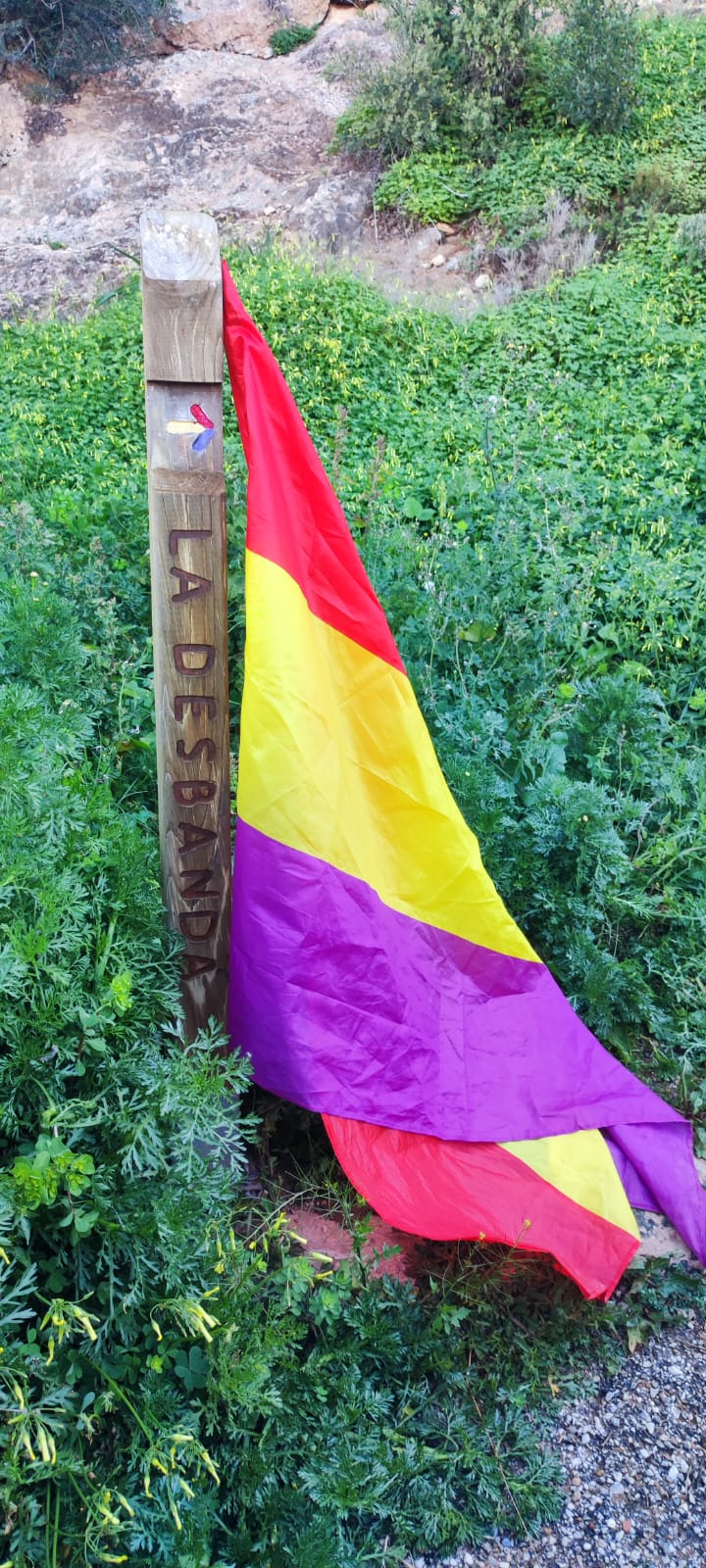
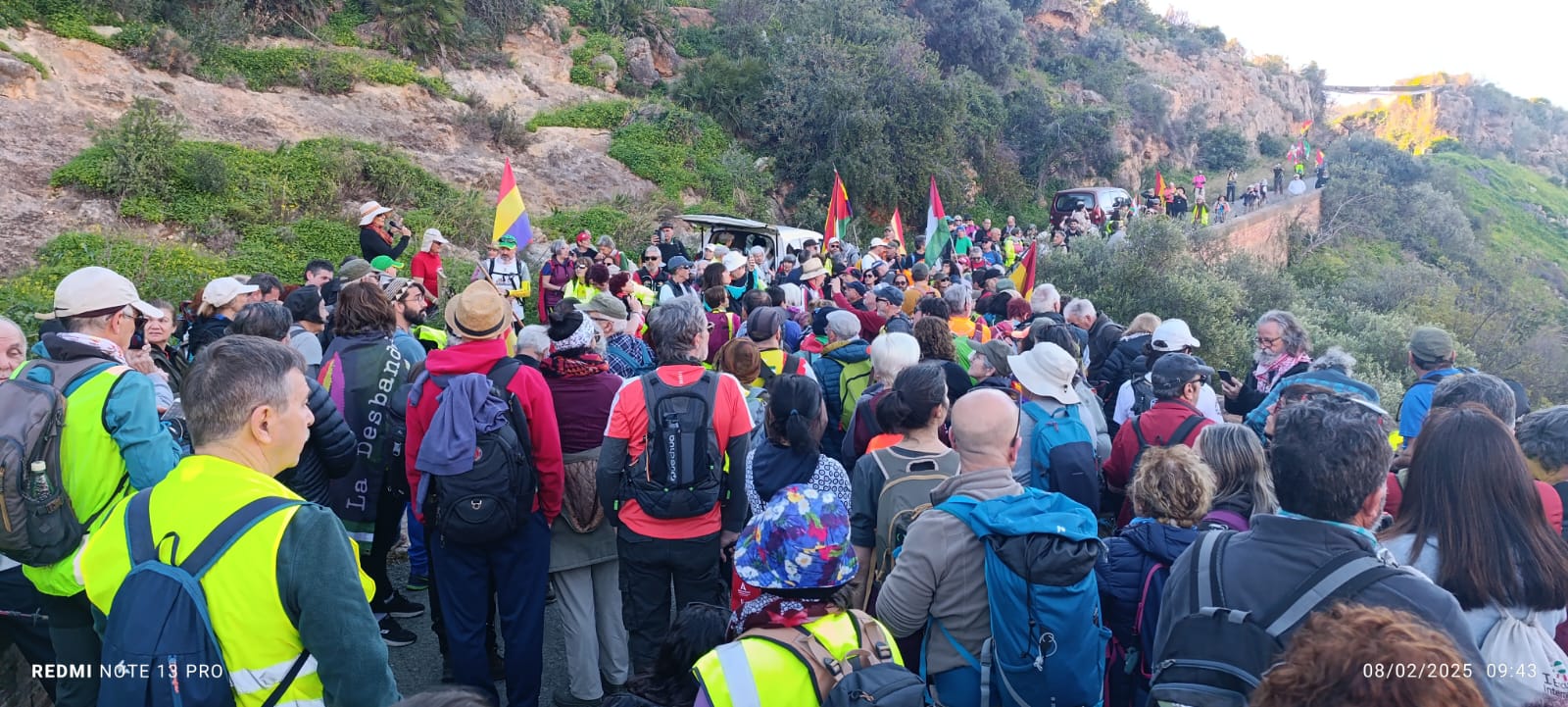
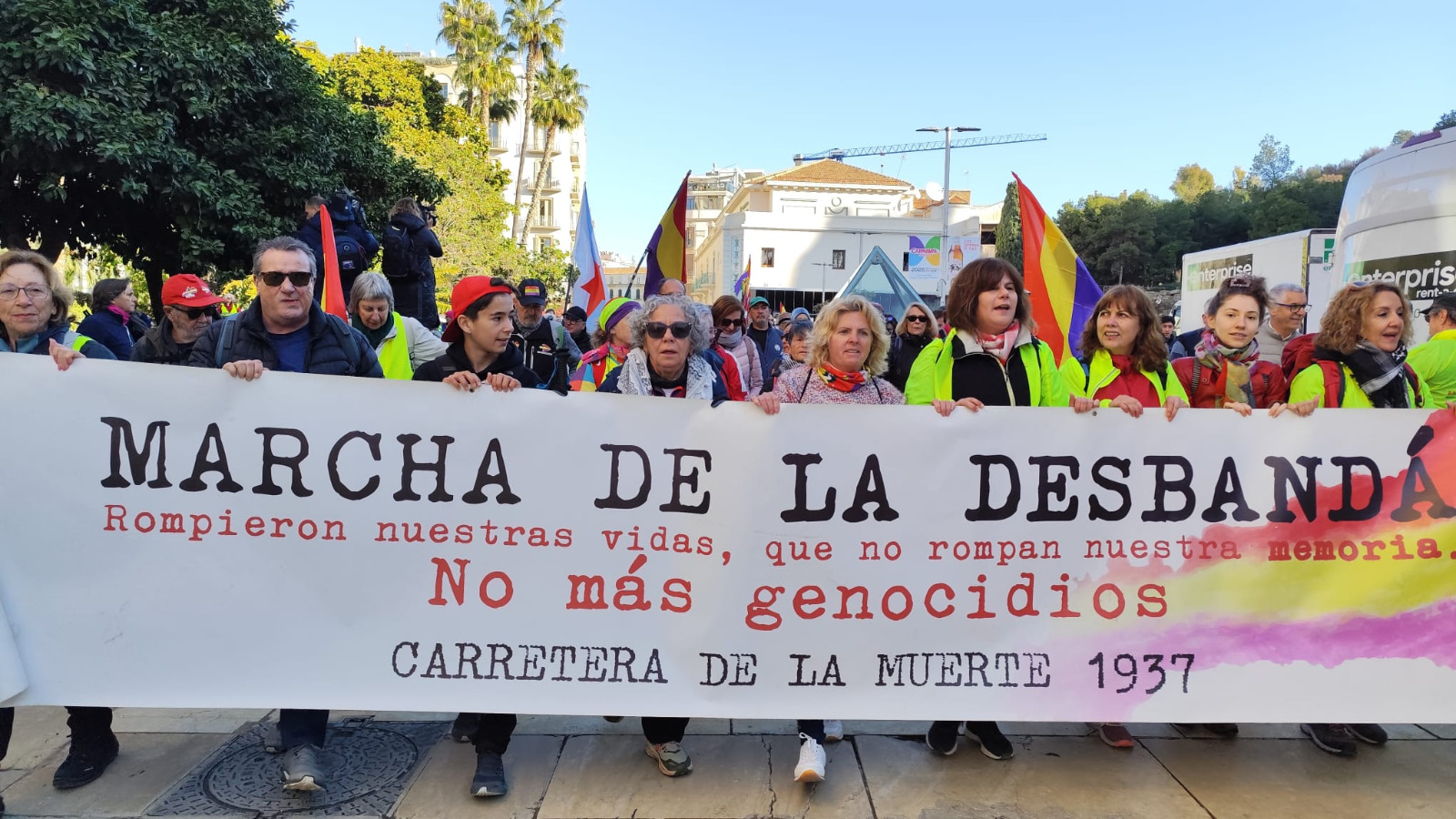
Known as La Desbandá, the ten-day march I joined for a day this month, saw hundreds of people walking along the hard shoulder of the N340 highway and along beaches and footpaths on a 220km route along the southern coast of Andalucía. We were walking in the footsteps of the 300,000 refugees, two thirds of the population, who set out from Málaga and other towns and villages in February 1937 in the civil war that had followed the previous year’s attempted coup d’état. These refugees were fleeing the imminent arrival of Franco’s troops under General Queipo de Llano, whose terrifying threats were broadcast repeatedly on the radio. Their desperate hope was to reach the provinces to the east, still under Republican control.

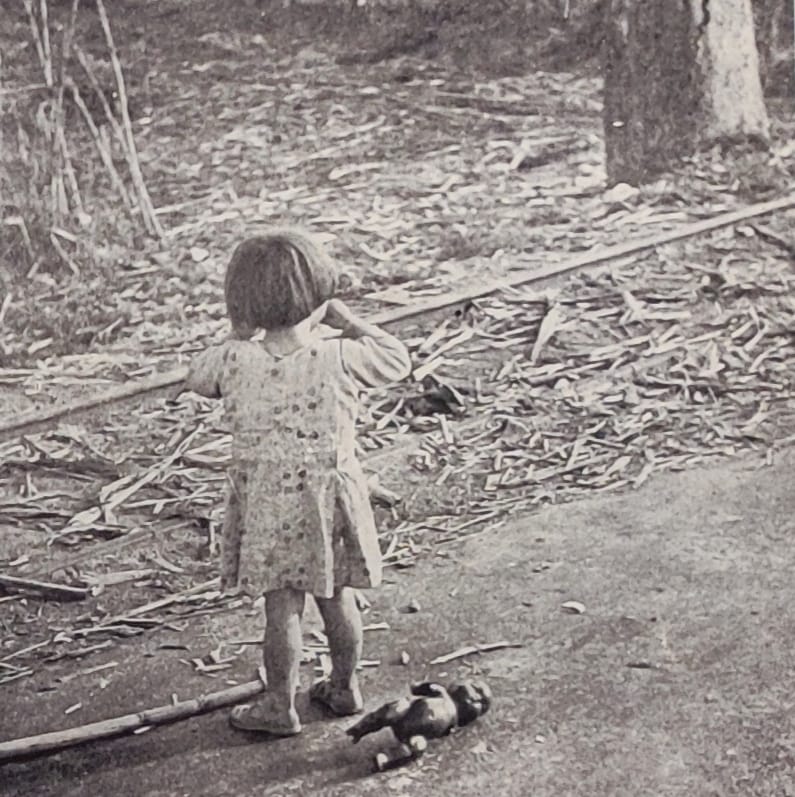
The political and military leaders of the Republic had already abandoned Málaga and knowing the fate awaiting them, panicked families took to the road, carrying what they could, some with their mules or donkeys, many with babies in arms, small children, the elderly and the sick. Starving, crippled, exhausted, they trudged on, many barefoot with terrible sores on their feet. As they walked, bombs were rained down on them from German planes, from Spanish warships and from the tanks and troops of the Italian and Moroccan armies supporting Franco. At least five thousand died on the road, later renamed the ‘Road of Death.’ Some died from exhaustion, cold or hunger or from their wounds; many more from the bombing. Those who continued had to abandon not only their meagre belongings but also their dead, most of whom were children, the elderly and women.

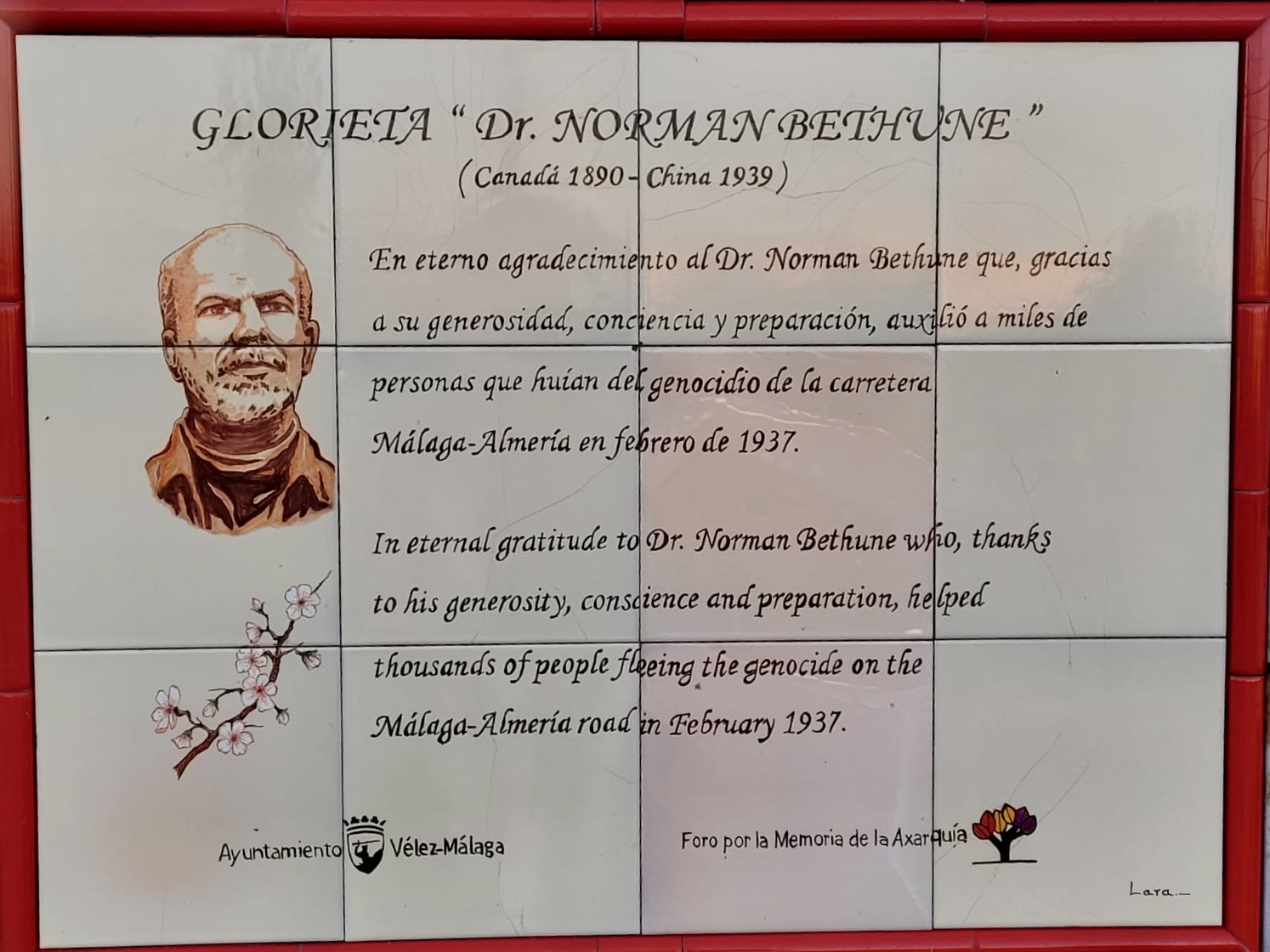
Some were more fortunate, saved by the arrival of a Canadian doctor, Norman Bethune, famous for his pioneering blood transfusions, along with a battalion of the Republican army and two of the International Brigades, who gave some protection at the front and rear of the trail of refugees. A memorial plaque in Norman Bethune’s honour can be seen in Velez Málaga.

Marching in the Desbandá, an annual event since 2017, was an emotional experience. The terrors and physical hardships endured by the refugees in 1937 played constantly in my imagination. No way can the commemorative march be compared, but neither is it an easy walk. Those completing the whole distance march up to twenty kilometres a day, sleeping on the floors of sports centres along the route. Many of the hundreds of participants were in their sixties and seventies or older. Some had been among the refugees of 1937, small children at the time. Many others were the children or grandchildren of survivors and had family stories, moving testimonies of what happened to their relatives.

In one part of my novel, The Red Gene, English nurse Rose is working with some of the victims in a convalescent hospital in Murcia. She speaks of the trauma and suffering of the children and their mothers, the physical and mental effects of their experiences.

‘Franco, Señorita, Franco!’ The little boy clutched at Rose’s uniform as the air raid siren sounded its ominous screech. The children leapt out of their beds, running to her in terror. The nightmare of their retreat from Málaga was still with them. Rose could not erase from her mind the horrific scenes described by the mothers of these children – those who had survived. The nightmare of being attacked from air and sea, machine-gunned and bombed as they fled with what possessions they could carry on their backs or in overloaded carts. The nightmare of seeing men, women and children dead or dying in ditches, mules lying feet up in the air by the roadside.

Almería and Murcia were now swamped with refugees. Attempts to distribute them around neighbouring villages and set up children’s colonies had been partially successful. However, the local population had scarcely enough to eat and with such an influx, malnutrition was rife. Rose was horrified to see a four-year old boy with limbs no bigger than those of a six month old baby. Where there should have been muscles, repeated hypodermic injections had caused the most awful abscesses.

The purpose of the annual march is not only as a homage to the refugees of the Civil War but also to bring to attention this genocide, largely forgotten or ignored, and to demand justice and reparation for the victims. It was the first case of a deliberate and indiscriminate massacre of the civilian population, repeated numerous times since and now seen in the terrible genocide in Gaza.

This year the entire route of the Desbandá was declared a Site of Historical Memory. Too much of Spain’s history of atrocities has been buried and forgotten. In today’s world, threatened by the rise of fascism, nationalism and authoritarianism, it is vitally important that we remember and honour the victims so that such horrors are not repeated.

La Desbandá: la tragedia de ‘La Carretera de la Muerte’, febrero de 1937

[WILL POST AN ENGLISH VERSION SOON!]

Era impresionante. También emotivo, ver los cientos de personas, muchas de ellos y ellas mayores, pero no faltaban jóvenes, e incluso un par de familias con niños pequeños, que participan este mes en la Desbandá, una ruta de alrededor de 200 kilómetros desde Málaga a Almería. Caminan en recuerdo y homenaje a los miles de víctimas de un genocidio horroroso, una masacre indiscriminada hace 88 años, cuando dos tercios de la población huyeron Málaga en febrero de 1937. Los lideres políticos y militares de la Republica acabaron de abandonar la ciudad y bajo el mando de Franco, las tropas italianas de Mussolini y el ejército marroquí estaban ya a punto de llegar, provocando terror y pánico entre la población civil. El terror de la gente tenía razón. El General Queipo de Llano que llevaba los sublevados había dado amenazas como estas:

“Ya conocerán mi sistema: Por cada uno de orden que caiga, yo mataré a diez extremistas por lo menos, y a los dirigentes que huyen, no crean que se librarán con ello: les sacaré de debajo de la tierra si hace falta, y si están muertos los volveré matar.”

“Nuestros valientes legionarios y regulares han demostrado a los rojos cobardes lo que significa ser hombres de verdad. Y de paso también a sus mujeres.  Esto está totalmente justificado porque estas comunistas y anarquistas practican el amor libre. Ahora por lo menos sabrán lo que son hombres y no milicianos maricones. No se van a librar, por mucho que berreen y pataleen.”

La gente llevaba lo que podía, incluso sus animales: familias con niños pequeñas en brazos, ancianos, enfermos… caminando día tras día, con llagas en los pies, algunos descalzos, dejando en la carretera por necesidad sus pocas posesiones y en muchos casos sus muertos. Algunos murieron de fatiga o de hambre en el camino; muchos más de los bombardeos por aviones alemanes o desde buques en el mar o por tierra, donde los atacaron los militares sublevados contra la República.

Me impresionaba también la participación en la Marcha conmemorativa de algunos sobrevivientes, gente mayor que como bebes o niños pequeños habían vivido esa pesadilla y tenían memorias, o al menos historias contadas por sus padres sobre el éxodo. Un gran número de los participantes caminan la ruta entera de ese homenaje (anual desde 2017). Otros, como yo, solo un día o varios días de las diez etapas, lo que puedan. Duermen en el suelo en centros deportivos para seguir el día siguiente. Durante la ruta hacen homenajes en sitios donde hay monumentos a las víctimas. Durante el día en cual participé en la Marcha, escuchaba historias de uno u otro participante, contando lo que habían sufrido sus familias en la Guerra y en los largos años de la dictadura. Eran familias normales, humildes, perseguidas y castigadas por ser republicanos, nada más.
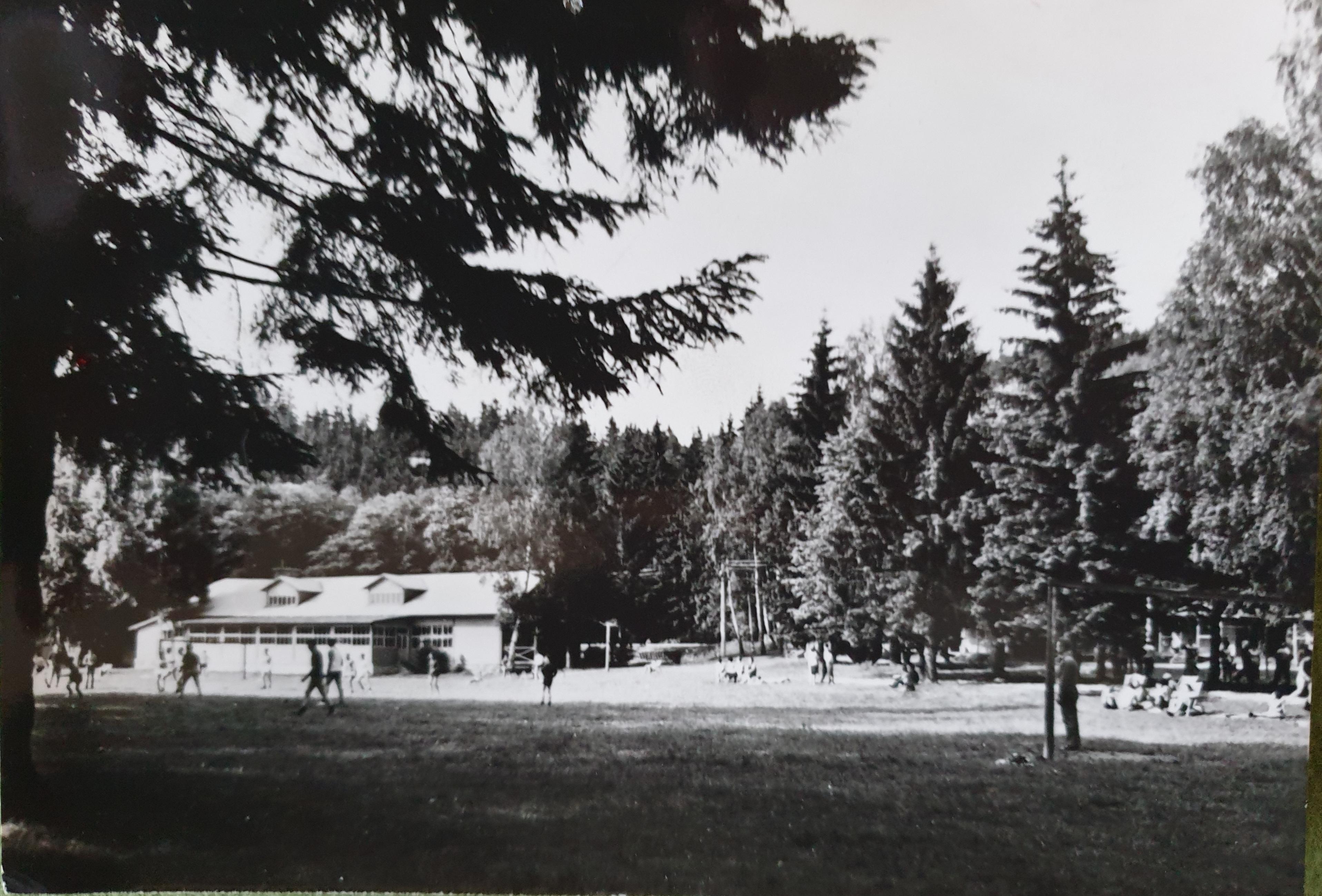
En Salobreña, donde vivo ahora, hay al lado del rio Guadalfeo, en el centro de una rotunda, un memorial a los refugiados. Los que habían sobrevivido hasta entonces esperaban salvarse una vez cruzado el rio, al llegar a territorio republicano. Pero ese año de 1937 después de mucha lluvia, el rio había crecido y el único puente había sido destruido. Los refugiados desesperados no tenían otra opción que intentar cruzar el rio, entrando en el agua. Algunos lo consiguieron; otros muchos fueron arrastrados al mar donde se ahogaron.

En mi novela, El Gen Rojo, hay una parte donde la enfermera inglesa Rose trabaja con algunos de esos refugiados en un hospital convaleciente en la provincia de Murcia. Habla del trauma y el sufrimiento de las mujeres y niños, los efectos físicos y mentales sufridos por muchas de ellas:

—¡Franco, señorita! ¡Franco! — El niño se aferró al uniforme de Rose mientras la sirena antiaérea emitía su siniestro chillido. Los niños saltaban de sus camas y corrían hacia ella aterrorizados. La pesadilla de la retirada de Málaga aún los perseguía. Rose no podía quitarse de la mente las horribles escenas descritas por las madres de aquellos niños, las que habían sobrevivido. La pesadilla de ser atacados por aire y por mar, ametrallados y bombardeados mientras huían con todo lo que podían llevar a la espalda o en carros abarrotados. La pesadilla de ver a hombres, mujeres y niños muertos o agonizantes en las cunetas, mulas tendidas con las patas en el aire junto a la carretera.

———

Almería y Murcia estaban ahora anegadas de refugiados. Los intentos de distribuirlos por los pueblos vecinos y de crear colonias infantiles habían tenido un éxito relativo. Pero la población local apenas tenía qué comer y, con semejante avalancha, la malnutrición hacía estragos. Rose quedó horrorizada cuando vio a un niño de cuatro años cuyas extremidades no eran mayores que las de un bebé de seis meses. Donde debería haber habido músculos, las repetidas inyecciones habían provocado unos terribles abscesos.

El otro propósito de las marchas memorialistas es rescatar del olvido la verdad de lo que pasó. Fue la primera vez en la historia en que la población civil se convirtió en objetivo militar en una guerra. Pero desde entonces… No ha cambiado nada. Esa barbaridad se repite hoy en día, en Gaza y en otros países, otras guerras, y vemos a diario imágenes y reportajes igual de horroroso. Por eso es importante que la gente sepa y aprende para no volver a repetirlo nunca más, ni en España ni en cualquier otro país. Con ese motivo, este año se ha declarado la ruta de la Desbandá como Lugar de Memoria Democrática.

2024: My Year of Not Writing

I blame it on the upheaval of moving. Of leaving Granada and the house I loved. I blame it on the vast amount of paperwork involved in selling and buying, the stress of negotiations with all the usual hiccups that inevitably accompany such transactions. I blame it on the year’s terrible and time-consuming task of sorting all my accumulated possessions and parting with many of them. I blame it on the energy I’ve devoted to making new friends and entering the life of my new pueblo. I blame it on my efforts to make a home that feels ‘me’ in this modern flat so different from my rustic house in Sacromonte with its inspiring views and closeness to nature. I blame it on my lack of willpower.

Dozens of ideas for new projects have raced through my brain. And out again before I’ve had a chance to develop them. Too many ideas can be as useless as no ideas. At other times my mind has been blank or distracted by numerous practical tasks, small decisions, attempts to organise my life. Establishing new friendships while ensuring I keep up with old friends in Granada is important to me, too important to put aside, however much time it takes. Moving to a new town where I knew virtually no one could have been a lonely experience. Instead, I’ve felt accompanied and welcomed and I’m hugely grateful for that.

What I have achieved and which is, of course, related to writing, is the publication of, a Spanish version of The Red Gene. Working with my translator Jon was a delight, a highly rewarding experience for both of us, and I’m thrilled now to see El Gen Rojo on the shelves of bookshops and receiving positive feedback.

I can’t remember another year like this one, a whole year without writing. I worry that I’ve lost the habit and that the endless wait for responses from agents and publishers to my submissions of the two novels written since finishing The Red Gene has killed off my motivation. But enough of excuses. A new year is the perfect opportunity to make a fresh start, to find new inspiration. With luck and determination, 2025 will be, must be, the year I get to work again, with my priorities firmly set in the write direction (apologies for the pun, couldn’t resist it!).  

La Experiencia de Colaborar con un Traductor

Después de varios meses de trabajo intenso por mi fenomenal traductor, Jon Berasategui, la traducción de mi novela, The Red Gene, ya está a punto de salir,  publicada por Ediciones Carena con el título El Gen Rojo. Ha sido un gran placer colaborar con él. También ha sido un proceso de aprendizaje enorme para mí. Encontré por primera vez expresiones como ‘pasado el arroz’ (over the hill), ‘montaña rusa emocional’ (emotional rollercoaster), ‘saltar la liebre’ (let the cat out of the bag), ‘tirar la casa por la ventana’ (to splash out) o mi favorita, ‘mandar a alguién a freír esparragos’ (tell someone to go to blazes). Todavía me equivoco con las formas y tiempos de los verbos, aunque espero que menos que antes. Pero temo que nunca llegare a dominar la puntuación española; el uso de guiones en vez de comillas todavía me da por vencido.

En el ir y venir de nuestra colaboración, había ocasiones donde cuestioné una de las decisiones de Jon y después de hablar, nos pusimos de acuerdo con un cambio o con mantener su elección de palabra o frase. Espero que Jon esté de acuerdo que el proceso, a veces compuesto de varias rondas de diálogo entre nosotros, siempre haya sido amable y respetuoso. Tratar con un autor que tenga cierta fluidez en el idioma puede ser pesado para el traductor. Por otro lado, de vez en cuando un malentendido necesitaba explicaciones de mi parte. Por ejemplo, incluso los traductores con más fluidez en el idioma probablemente no conozcan el tratamiento Matron para la enfermera jefe en un hospital o que top-heavy significa algo especifico cuando refiere a la figura de una mujer.

Para traducir una novela, hay que enfrentarse a miles de decisiones en cada momento. Una de las cuestiones básicas es decidir hasta qué punto hacerla de manera literal. La posibilidad de traducir con libertad es esencial en una obra literaria, siempre que se retenga el significado y el ambiente del original. Esa expresión ‘go to blazes’, mencionada arriba, es un ejemplo del lenguaje anticuado que utilizaba a veces para el diálogo en las secciones más históricas de una novela que abarca unos setenta y cinco años y que constituye un desafío más para el traductor. Es un factor adicional para tener en cuenta cuando trata de elegir el equivalente más apropiado en español. Por ejemplo, las formas de tratar a las personas (tu o usted) tienen que reflejar los costumbres de la época y no del presente. En generaciones previas el estatus social llevaba más importancia que hoy en día; la gente era más formal, en España tanto como en Inglaterra. Me acuerdo de una ocasión (pero solo una) cuando Jon tenía dudas y me consultó sobre esa cuestión.
Algunos de los personajes españoles en el libro cometen errores cuando hablan en inglés. ¿Cómo comunicar eso en una traducción? De modo parecido, se han expresado en la traducción algunas partes del diálogo hablado por ingleses reflejando los patrones de habla cortés del inglés. Por ejemplo, uno de los personajes ingleses dice: “I suppose I’d better introduce myself”. En la versión en castellano está escrito como “Supongo que será mejor que me presente”, una redacción que ningún español emplearía. Es una cuestión de juicio que necesita mucha reflexión y cuidado, y no solo una vez pero en cada frase. No puedo imaginar que jamás existiera un bot de IA con la habilidad y percepción de un buen traductor humano. ¿Confía en Google Translate para traducir una novela que tardó años en escribir, años de trabajo y energía emocional? No way! ¡Ni hablar!
Nos conocemos en persona por primera vez justo antes de la fecha de publicación

Salobreña: my new life starts here

Preparing to leave the UK, where I’d spent several weeks away from the heat of southern Spain in the company of family and friends, the thought of going “home” brought up very mixed feelings. That’s not unusual: I always miss my children and grandchildren more intensely after having them nearby, while looking forward to my return to Granada. This time though, I was not returning to what I still think of as home, but to my new abode on the coast, to Salobreña and the flat I occupied for a mere two weeks before flying off to England.

I arrived late in the evening, too late for the last bus, so it was a taxi that whisked me in what felt like the wrong direction. Had I made a terrible mistake with this move? Would I be able to settle in a small coastal community after the buzz of Granada, a university city with a rich culture and history? The air felt hot and sticky; the temperature a degree or two lower than in Granada but with much higher humidity.

Arriving in my flat, I found it in darkness: at some point during my absence the power had tripped. This might not have mattered if I’d emptied the fridge before leaving. Along with its contents (fortunately minimal) it was now mouldy and foul-smelling. Even after cleaning, the smell still lingers. The climate on the Costa Tropical differs from Granada in that night temperatures here drop only a degree or two, making sleep difficult. Having just ordered the first essential, a washing machine, I can see that a ceiling fan for the bedroom will have to be my next priority.

“We take cold showers every hour during the day,” confided one friend. It’s the only way.” This is the worst time of year for humidity, everyone tells me. I remind myself that at least winters will be easier than in Granada, where I nearly froze to death in my cold house. Another compensation for the discomfort I’m suffering lies in the abundance of cheap, locally grown tropical fruits on display in every greengrocer’s. I’m feasting on peaches, plums, mangoes, melons and avocados, to name just a few. All are ripe, juicy and full of flavour.

I’m sure I’ll become used to my new life after a few weeks or months. Autumn is the ideal time to be on the beach and swimming in the sea: for me it’s the best type of relaxation. I look forward to that and, once the heat subsides, to exploring the area around Salobreña on foot and by bike; to making new friends and reconnecting with old ones from Granada, which is not very far away at all; to welcoming my family who all love the seaside.

fullsizeoutput_12e7

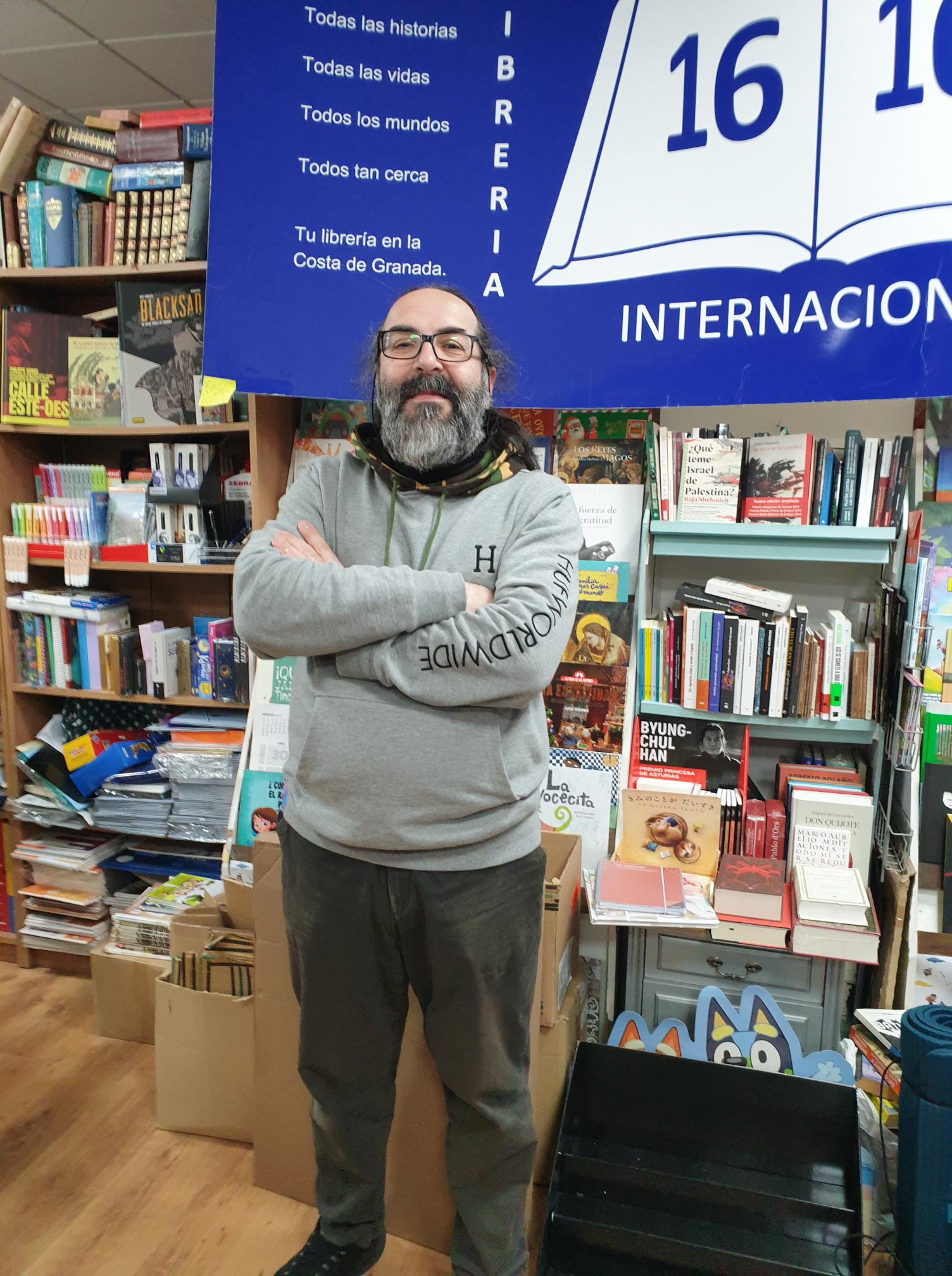
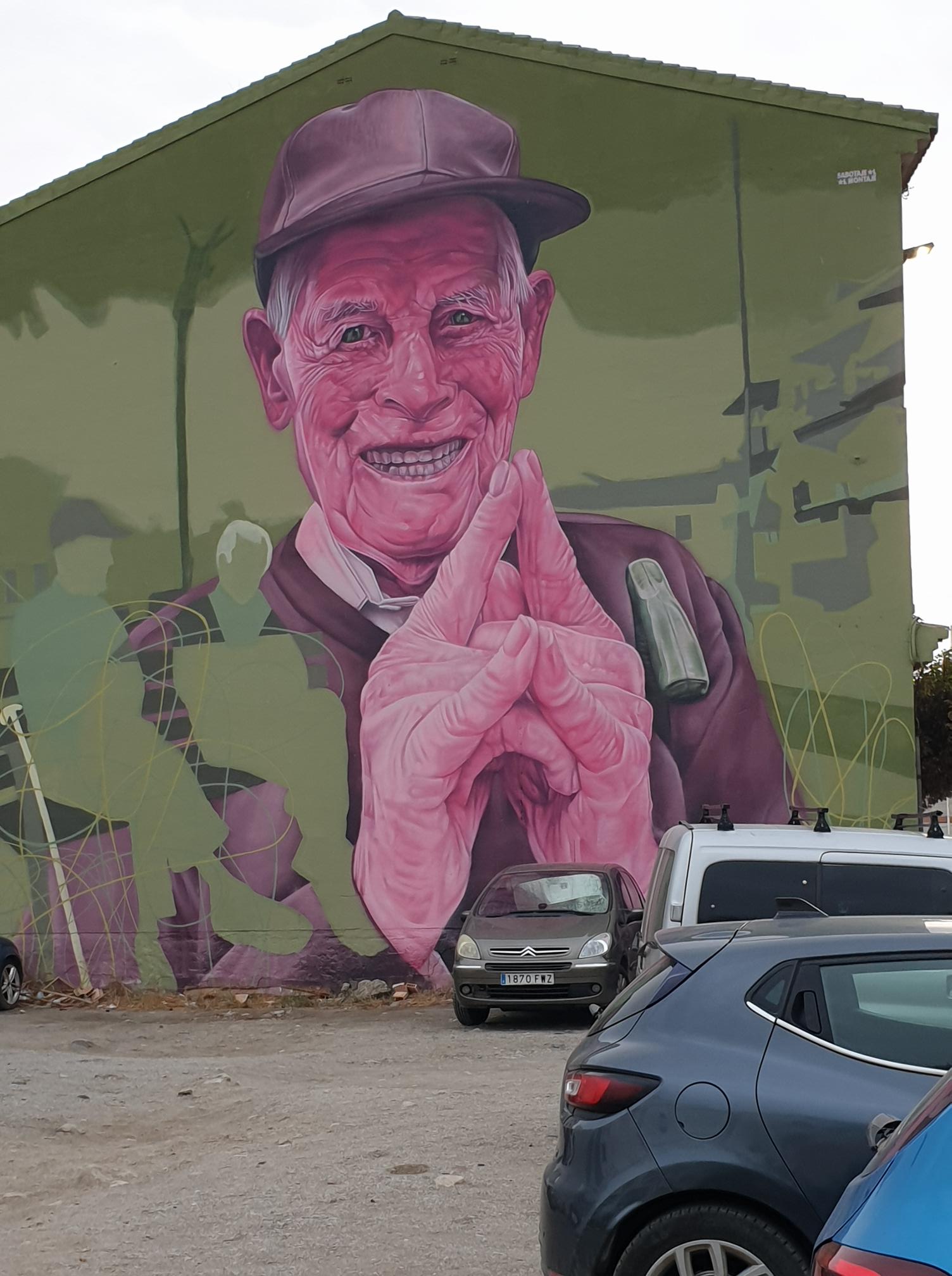
Salobreña has much to recommend it, including a picturesque historic quarter on a hill with a castle. As you approach by road from Granada, the view of its sugar-cube houses clustered beneath the castle with the sea in the background is stunning. The Casa de Cultura organises many interesting events – talks and films and concerts. Antonio, owner of the fantastic bookshop, Librería 1616, and the public library ensure that literature features strongly in Salobreña’s cultural life. A recent Arts Festival resulted in colourful and eye-catching murals scattered around the town, one of them right opposite my flat. A few photos will convey better than words the attractions of my new surroundings.

Working with a Translator

After several months of hard work by my brilliant translator, Jon Berasategui, the Spanish version of my novel The Red Gene is now done and will be published later this year as El Gen Rojo. Working with Jon has been a delight. I hadn’t really considered beforehand the level of trust required of an author. Has my translator fully understood the subtleties of the English language, why I chose this word or phrase over another? In almost all cases the answer was yes and my trust increased as the work progressed. An author reasonably fluent in the language can potentially be a pain for the translator so I could only admire Jon’s patience with my doubts. In the to-and-fro of our collaboration there were occasions where I questioned one of his choices and after some discussion we agreed on a change; in other cases we made a joint decision to stick with his version. I hope Jon would agree that this process, at times involving several rounds of dialogue between us, has always been friendly and respectful.

Working with Jon has been a huge learning process for me. Expressions (literal meanings in brackets) such as pasado el arroz (past the rice) for ‘over the hill’, montaña rusa emocional (emotional Russian mountain) for emotional rollercoaster, saltar la liebre (let the hare loose) for let the cat out of the bag, tirar la casa por la ventana (to throw the house out of the window) for splash out and my favourite, mandar a alguién a freir esparragos (to send someone to fry asparagus) for telling someone to ‘go to blazes’, were all new to me. My grasp of verb forms and tenses still feels shaky but I hope it has improved a little. On the other hand, I don’t think I’ll ever quite get the hang of Spanish punctuation. Using dashes instead of quotation marks defeats me still.

That English expression ‘go to blazes’ is an example of the dated language I sometimes used for dialogue in the more historical sections of a novel that spans some seventy-five years and which makes the work of the translator even more challenging. It’s yet one more factor to take into account when choosing the most appropriate Spanish equivalent. As a simple example, the forms of address (whether to use the familiar tu or more formal usted) have to reflect the customs of the period. Usted is little used these days, at least in Andalucía, but as in Britain, social status in Spain was more pronounced in previous generations.

Some of my Spanish characters make mistakes when speaking English. How to convey this in a translation? Similarly, some of the dialogue spoken by English characters has been phrased in the Spanish translation in a way that reflects English speech patterns. For example, one of the English characters says, “I suppose I’d better introduce myself”, which appears in the Spanish version as “Supongo que será mejor que me presente”, a phrasing that I don’t think a Spaniard would ever use.

Translating a novel inevitably involves countless decisions at every point. One of the basic issues to be decided is how literal to be. There should be scope to translate more freely as long as the meaning and mood are retained. It’s a question of judgment that has to be carefully considered – not just once but in every sentence. I can’t imagine AI ever managing this with the skill and perception of a good human translator. Would I trust to Google Translate a novel that took years of hard work and emotional energy to write? No way! ¡Ni hablar!

Every postcard tells a story

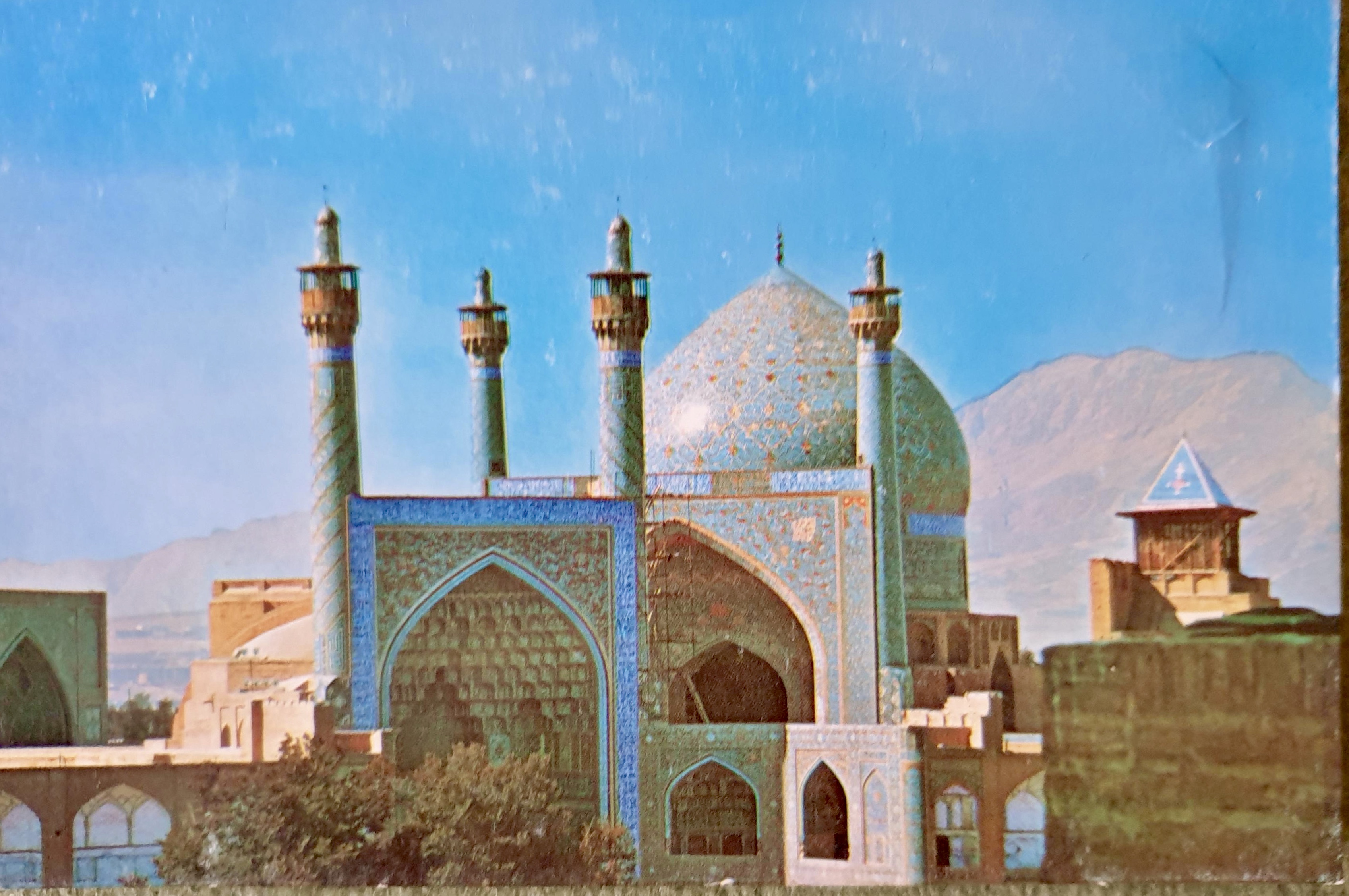
Esfahan, Iran from my travels in 1974

With a house move in prospect, it has become clear that I can no longer let my hoarding instinct go unchallenged. If I throw away a few things every day, maybe by moving day in June I can pare down my possessions enough to fit into the small flat I’ll be occupying. A stack of folders, a wad of miscellaneous papers, one shelf of books, a small section of my wardrobe or half an underwear drawer every day… Do I really need those sexy pants any more when nobody sees them but me? The socks with worn out heels I could use as dusters? The T-shirt that’s ridiculously tight or impossibly baggy or that has stretched so it reaches my knees but would be fine for a summer nightshirt. No, no and no.

In these days of instant communication by email, by WhatsApp, by social media, it’s a rare treat to receive a postcard, even though racks of them are still displayed outside every tourist shop. So, as part of my mission to discard what I don’t strictly need, I decided this month to tackle a large and dusty shoebox crammed with postcards from all over the world. Skimming through them, I realised they dated back to 1960 or before, to old primary school friends I haven’t heard from since. My French penfriend when I was fourteen. An ex-lover, sadly no longer alive, signed with a single initial. My children at different ages, with a clear progression in their handwriting and spelling. My cards to them as well: Darling Tom and Corinne… missing you so much. My Russian friend on International Women’s Day, long before it was celebrated or even heard of in the West. Passing friends whose names mean nothing to me, and those I’m still in touch with but who no longer send cards from every holiday (or any) as they did for years, it seems.

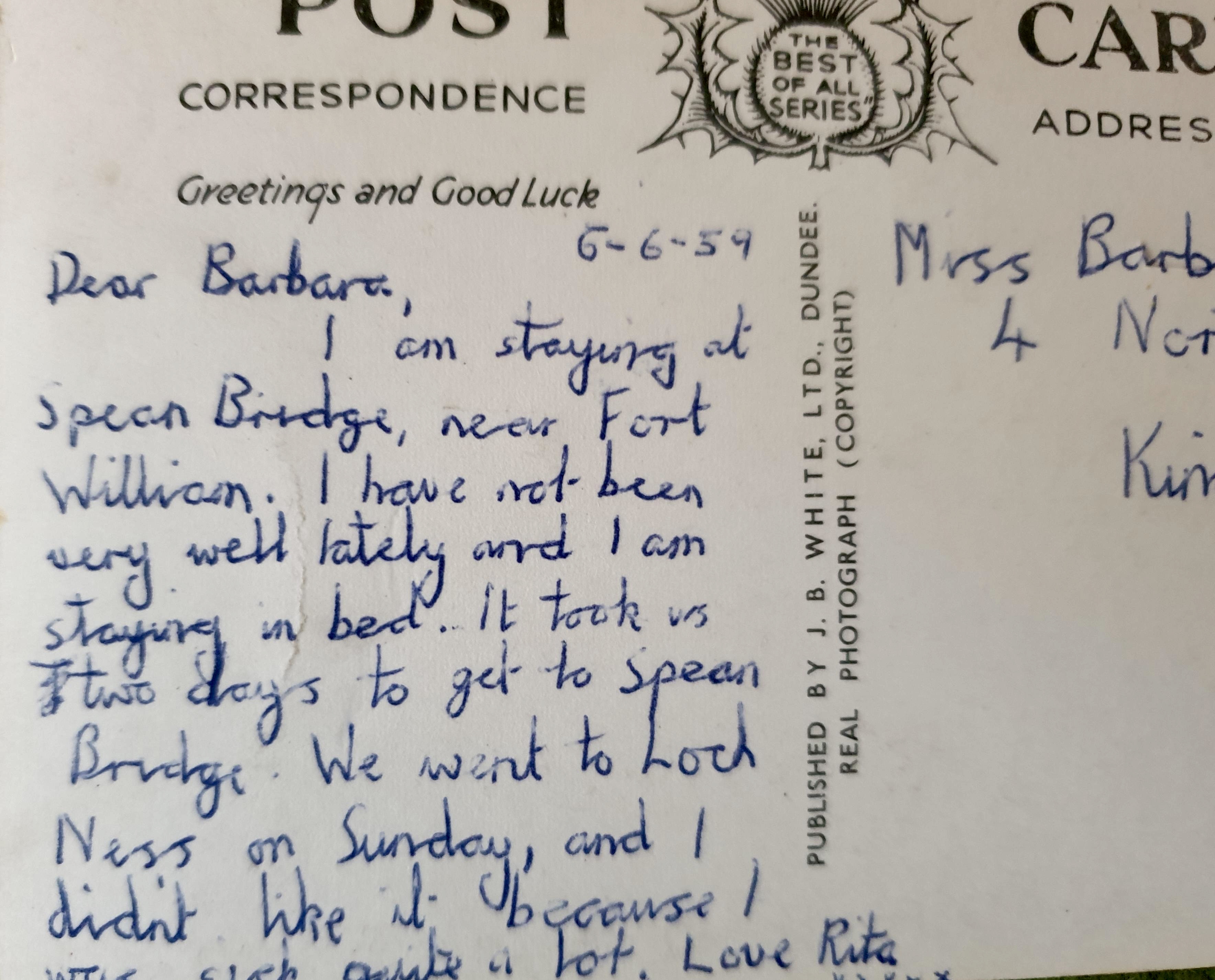
From a friend in 1959
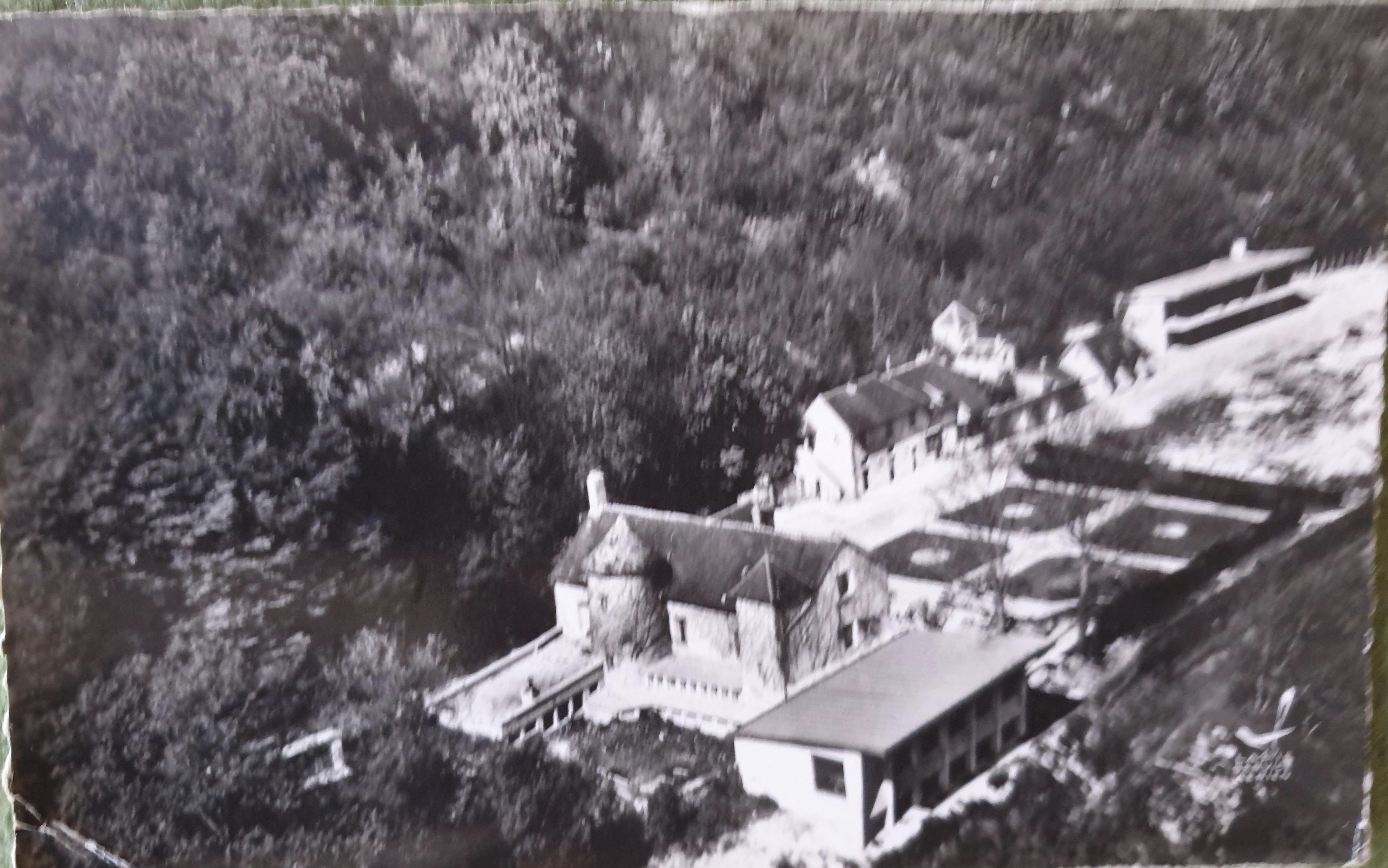
Boncourt in France where I stayed in the mid-60s
Early 60s postcard with a 3d stamp
Czechoslovakia 1967
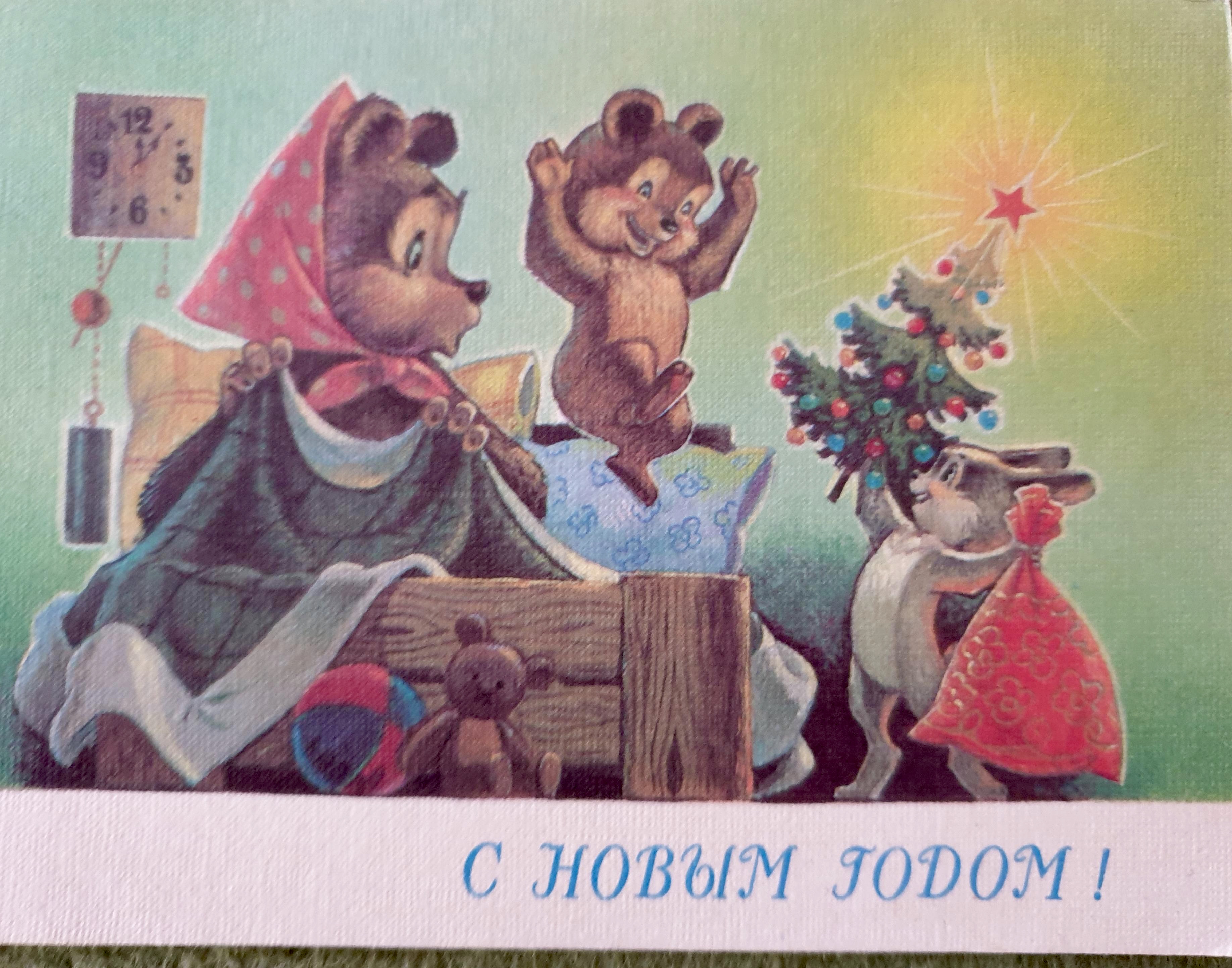
New Year’s card from Irma, a Russian friend met on the Trans-Siberian railway in 1975
Correspondence with Irma continued for 20 years

So many stories these cards could tell. I imagine their journey from Zimbabwe or Chile, South Africa or Mexico, Russia or Bali. Or from places as familiar to me now as Granada, Málaga and the Alpujarra, long before I ever imagined living in Spain. Remote corners of Ireland from the late sixties, countries that no longer exist like Yugoslavia; the many exotic destinations of the cruise ships my daughter worked on over twenty years ago: the Antilles, Alaska, New Orleans; my son’s world travels before settling down to a career and family: Zanzibar, the Australian outback, Buenos Aires. But I also find cards from Birmingham or Manchester, cards with animals, museum exhibits or paintings, awe-inspiring mountains: Annapurna, the Alps. Those picturing resorts with sandy beaches are the minority. The quality of the photos improves the later the dates – garish colours become more subtle, angles more original.

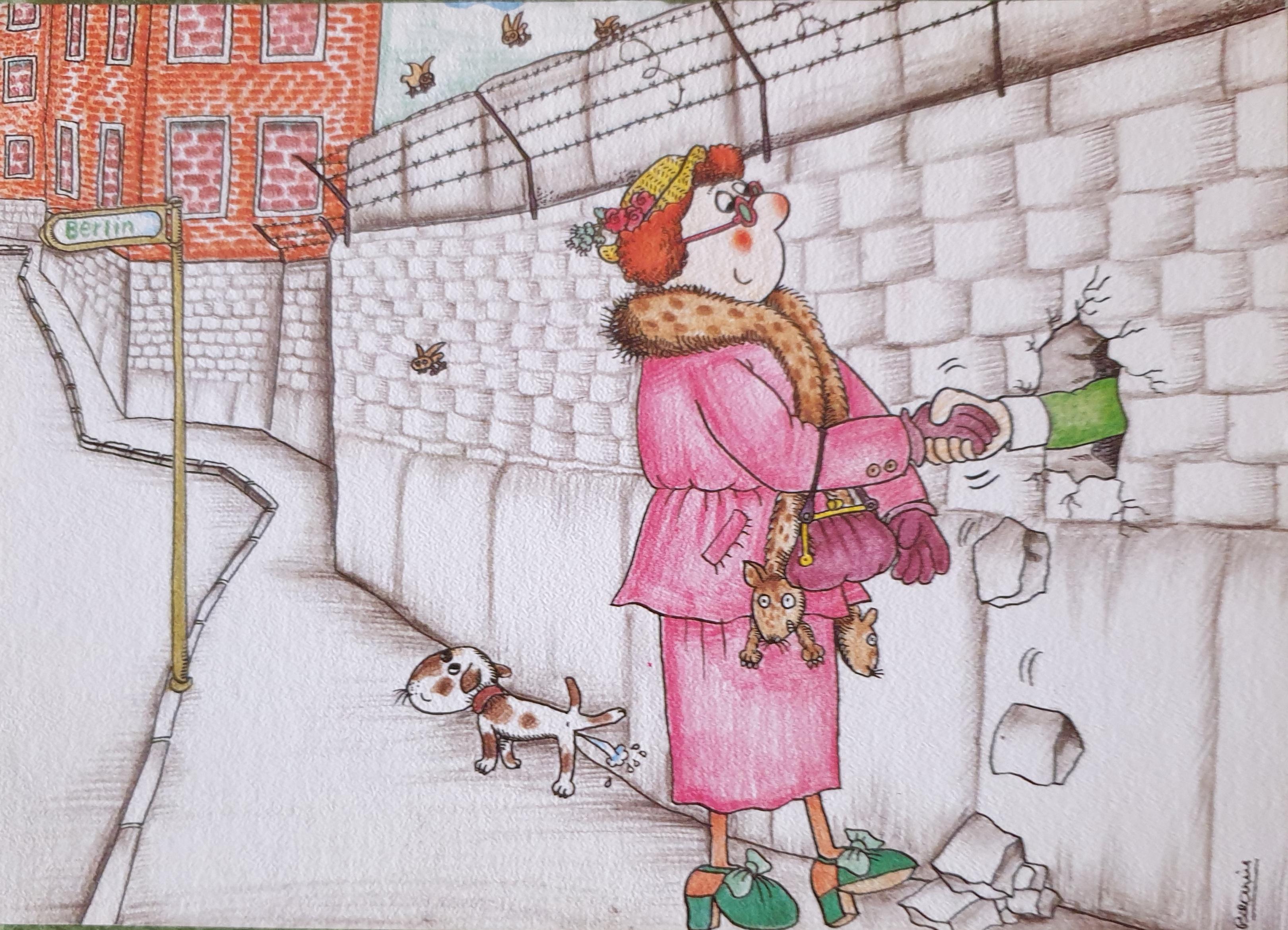
Berlin soon after the fall of the Wall

The words tend to be banal, the weather being the most dominant subject. Those with original or humorous messages are a treat, but every single one was welcomed and enjoyed at the time. I could imagine them being written under a beach umbrella or perched on a hotel bed, at a restaurant table splashed with oil or wine or on the deck of a ship. Or perhaps on the steps of some Hindu temple or Crusader castle.

I’ve cut off the stamps to give to a stamp-collecting friend. They too tell a story. British stamps for a halfpenny – that’s ½d, from the days of pounds, shillings and pence; stamps with athletes, astronauts, flowers and much else, not just kings or queens or presidents.

New Year, New Horizons

They called me brave when in my twenties, at very short notice, I accepted a friend’s suggestion and we took off for Kathmandu on a three-month long overland journey in a truck, camping in remote places where the local people found us as strange and fascinating as we found their communities and landscapes; crossing deserts, mountains and rivers; confronting suspicious and sometimes aggressive guards at one border or another.

They called me brave when in middle age I left my settled life in Shropshire and headed alone to Granada to start a new life there where I knew no one and had nothing solid to go to, neither job nor home.

Twenty-five years on, I’m contemplating another big change (or it seems big to me after twenty years in the house I love in Sacromonte). In terms of distance, my planned move to Salobreña on Granada’s Costa Tropical is not great but it will take as much courage as those previous leaps in the dark. Age makes a difference and I’m not as brave as I was. Doubts were still assailing me as I signed the preliminary contract this week and paid the ten per cent deposit.

I’ve never put down roots for so long in one place. How can I bear to leave when I’m so rich in friends and my social ties and networks are all centred on Granada, most of them in my immediate neighbourhood? I will of course keep up my friendships as much as possible. Salobreña is only an hour or so away on the bus, (two hours taking into account the town bus from Granada’s bus station, which is some way out) and many of my friends have cars, though I don’t. If I’ve managed to stay in touch with old friends in England for twenty-five years, I can surely manage to continue seeing my Granada friends. Even so, it will be a wrench.

From the window by my desk here I have views of the Generalife and trees. I’m convinced these views help give me creative inspiration. Will it be the same in a flat where the windows look across to other flats? From my new terrace I can see mountains, but in between is the main coast road with a constant stream of traffic and a petrol station. On the plus side, I have the sea close by, only a twenty-five minute walk away, less by bike. I’ve always been inspired by the sea – swimming in it, listening to the lapping of waves, observing its changing colours and movements, on calm days or stormy ones.

A milder climate both summer and winter will make life more comfortable and I won’t have the daily challenge of steep hills, uneven cobbles and flights of steps to contend with. I’m thinking ahead to a time when I’m not as fit as now. Cycling will be easier in a relatively flat town (but which also has the charm of a casco histórico on a hill with a castle at the top. And that’s not to mention my favourite bookshop, Librería 1616 and its enthusiastic owner, Antonio. I’ve presented both my Spain novels there; they sell more of my books than any other shop.

While one part of me is already mourning the losses to come, another part is excited by the idea of starting a new life in a new place, forging new friendships; once again taking on a challenge. If I stay where I am, I could so easily get into a rut, sticking to old routines within my comfort zone. A move will act as a stimulus, possibly opening up exciting possibilities I cannot imagine in advance.

In the meantime there remain to me a few more months to make the most of the time I still have in Granada. I will be taking countless memories with me even as I discard many of the accumulated possessions of twenty-five years – books, clothes, abandoned writings, mementos from my travels – that won’t fit into a small flat. I will no doubt feel nostalgic for my time in this privileged setting. A few photos of my surroundings might explain my ambivalence about leaving.

Immersing myself in the 1980s

My two published novels, Secrets of the Pomegranate and The Red Gene, are set in Spain; the following one (Flying Blind, currently with an agent) tracks my peripatetic grandmother as she moves between some half dozen European countries. But for my latest novel, I’ve returned to the UK.

The setting for Scent of the Fox (provisional title) is southern England in the 1980s. Does that make it historical? Those forty years have seen many changes. Despite closely following the news from Britain, when I visit or talk to friends and family there, many references are lost on me, whether it’s personalities, TV programmes or products. What is a squishy? Bubble tea? I manage to unravel some of the mysterious acronyms – WFH, for example; others, like OOO and SUP, have to be explained to me. The use of cash (your actual notes and coins) seems to have become obsolete, even for purchases of a few pence. And where are the banks? I realised that while I could do contemporary Spain, contemporary Britain after nearly twenty-five years out of the country would be difficult. I’m too out of touch with the culture and lifestyle to portray it authentically.

Britain in the 1980s, on the other hand, feels quite familiar. To write Scent of the Fox, I had to immerse myself in that decade, mining my memory and supplementing it with research. The politics, the fashions, the language, the music… Shell suits, Doc Martens, rah-rah skirts; the mullet hairstyle for men. Ghostbusters and E.T; Madonna, Wham and Boy George… Passing crazes like Deely Boppers (those silly hairbands with antennae, two balls on springs, attached), jelly shoes and bracelets, Care Bears and leg-warmers. My children were growing up then, with Fisher-Price toys and Lego and roller-boots. Sindy dolls and Action Man, My Little Pony and Space Hoppers were everywhere. Screens? We didn’t even have a TV till about 1990 – highly unusual, I’ll admit. But there was no social media, no email, no mobiles or tablets. You listened to music on a Walkman. And children played in the street. Family-friendly cafes, let alone pubs (unless they had gardens) were a rarity. Teenagers hung out in McDonalds and thought it was cool.

My children also joined me at rallies and on demonstrations, proudly holding up banners against nuclear weapons, apartheid or acid rain. It was the Thatcher era, with the miners’ strike, the Falklands War and the demonisation of single mothers dominating the news. The nuclear threat felt terrifyingly real; climate change and environmental destruction, though important, seemed a little less urgent – in contrast to now. Plastic had not yet taken over the planet; it was the trees we needed to save, and the ozone layer. The rainforest must be protected, CFCs banned.

My novel is set in that world of protest, my main character, Jen an activist invested in all the above causes. To me it’s a familiar world; to my potential readers it may not be. I am seeing that world of the eighties through the eyes of my two young protagonists – one thirty, the other in her early teens. It is their voices I use, though some of the more minor characters are from older generations. I was in my thirties in that decade and an active campaigner against nuclear weapons and power, among other causes. Jen is not based on me but I can project myself back to that scene. I can also vividly recall my teenage years which, even though they predated hers by a couple of decades, helped me get into the head of Rachel, my younger protagonist.

The beaches of Argelès-sur-Mer: from internment camp to holiday resort

When my children suggested a week’s family holiday at Easter on a campsite close to Argelès-sur-Mer, a shiver passed through me. My research on the Spanish Civil War made the name of this small town on the French coast, not far from the Spanish border, hauntingly familiar. I knew of its long sandy beaches – but not as a tourist attraction or holiday resort. For me, its beaches evoked scenes of suffering and death, where two hundred thousand Republican exiles from Spain had been confined in the concentration camps set up in February 1939 at the end of the Civil War.

fullsizeoutput_1318

Refugees from all over Spain, including children, the old and sick, the war-wounded, Republican soldiers and members of the government fled to France after the fall of Barcelona in January 1939, making for the border at Le Perthus or over the snow-covered Pyrenees. In ten days, half a million Spaniards arrived at the border, having trudged with whatever they could carry of their possessions in what became known as La Retirada. As they walked, they were shot at from the sea and bombed from the air by Franco’s forces, including his German and Italian reinforcements.

fullsizeoutput_1314

Of those who made it across to France, many died of exposure, starvation or disease. The French, unprepared for such a huge influx of refugees, herded them into internment (or more accurately, concentration) camps, fenced in with barbed wire and guarded by armed soldiers and gendarmes. The north beach of Argelès-sur-mer formed the first and largest of these open camps, which barely conformed to the most basic conditions of health and hygiene. From February to June, the refugees confined there lived in makeshift shelters or were forced to dig holes in the sand for protection from the elements. ‘Carne fria’ (cold meat) was the term they used for those who had died of cold during the night in the hollows dug out in the sand.

fullsizeoutput_1315

From September 1939, wooden shacks were constructed to house the women and children. Others were sent to refuges across France along with some of the injured and sick, but many remained trapped in the camps. Later, under the Vichy regime, the camps became more international. The Spanish Republicans were joined by other ‘undesirables’ including stateless persons, foreign Jews and Romani.

Although I didn’t encounter any ghosts (as I’d half expected to), I found many reminders of La Retirada. Whereas in Spain, the country’s 20th century history is often swept under the carpet, on the French side of the border this did not seem to be so. In the town of Argelès, a small museum bears witness to the Spanish exiles and their journey with photos, documents, maps and an interactive exhibition. There’s an annual commemoration, Chemins de la Retirada, in the third week of February. A beach monolith was erected in 1999 at the former entrance to the camp in homage to the Spanish Republicans interned there. The town has a Spanish cemetery where those who died in the camps were buried and a tree dedicated to the seventy children under ten among them.

fullsizeoutput_1313

At Collioure, a few kilometres south of Argelès, an imposing fortress, the Chateau Royal, stands on the seafront, dominating the town. In 1939, it was transformed into a prison, its first occupants destined to be Spanish Republican exiles. The town is famed for its association with Spanish poet Antonio Machado, a Republican who fled Barcelona accompanied by family and friends in January 1939. Exhausted and ill, he stopped to rest and recover at the Casa Quintana in Collioure, where he died exactly a month after leaving Barcelona. His tomb in the town’s cemetery has become a place of pilgrimage. When I visited, a group of devotees were adding more flowers to the numerous bouquets already in place along with poems and messages. Collioure is now a pretty town with a great market and many artistic connections.

fullsizeoutput_1317

fullsizeoutput_1316

20230409_122043

Manuel Azaña, last President of the 2nd Republic also died in France after setting up a government in exile in the small village of La Vajol on the Spanish-French border. A bronze sculpture erected in the village pays homage to the exiled Spaniards. It was inspired by a photo taken by a foreign journalist and represents a man and his six year-old daughter on their long and torturous journey together with other exiles, to the border at Prats de Molló, after the girl lost a leg in the bombing by Franco’s troops in Monsó in November 1937.

monument-a-lexili-1-1453532

el exilio foto

In the town of Elne, a little way inland, a Swiss aid worker, Elisabeth Eidenbenz, appalled by the high number of maternal and infant deaths in the camps, raised enough money to fund the renting and conversion of an abandoned chateau into a maternity hospital. She oversaw its repair and renovation, completed in November 1939. From December that year she brought hundreds of pregnant women from the Argelès camp, providing them with a healthy and welcoming place to give birth and rest afterwards. She is credited with saving the lives of six hundred children. Decades later, her work was recognised and the former hospital building now serves as a memorial and museum.

280px-Maternité_Suisse_(Elne_-_66_-_France)

As refugees from other, more recent wars arrive on beaches in various European countries including Britain and are often treated with as little or less compassion than those fleeing the Spanish Civil War eighty plus years ago, the many memorials on the beaches of the Côte Vermeille and its small towns are important. Is it too much to hope that these sad reminders will help convince governments to take a more humane attitude to today’s refugees? The answer seems to be yes.